What Actually Happens Inside a Control Cabinet When You Add an Unmanaged Industrial Switch
Control cabinets are tight, hot, and electrically noisy. You’re stuffing PLCs, HMIs, IP cameras, drives, and maybe a cellular router into a steel box that already runs at 55°C ambient. The last thing you need is a switch that drops packets when the backplane can’t keep up, or one that reboots because a motor drive kicked a 2 kV surge onto the 24 VDC rail.
We see this every day at Wanglink. As a factory that designs the PCB, runs SMT lines, and burns in every port before shipping, we’ve shipped over 1.2 million industrial unmanaged switch ports into control cabinets and outdoor enclosures. The job of these switches is simple but unforgiving: forward frames at line rate between 5, 8, or 16 devices without a single configuration step, and keep doing it for years while the cabinet vibrates, bakes, and gets hammered by EMI.
This article breaks down what makes an unmanaged industrial switch actually reliable inside a cabinet—backplane throughput, surge handling, thermal design, and the factory testing that separates a device that survives from one that creates truck rolls.
The Role of Unmanaged Industrial Switches Inside Control Cabinets
Why Unmanaged, Not Managed? Speed, Reliability, and Zero-Touch in Harsh Spaces
In a control cabinet, you don’t need VLAN segmentation or SNMP traps. You need deterministic forwarding. A managed switch running Spanning Tree can add 30–50 seconds of convergence delay when a link flaps. That’s an eternity for a PLC polling I/O blocks. Unmanaged switches don’t run STP, don’t process IGMP snooping tables, and don’t have a CPU that can lock up. They forward frames based on a self-learning MAC table, with cut-through or store-and-forward switching at wire speed. For cabinet-to-cabinet daisy chains or star topologies connecting drives and vision sensors, this is exactly what you want.
Also, zero-touch matters. When a technician replaces a switch at 2 a.m. in a wastewater pump station, they don’t want to load a config file. They want to snap a DIN rail clip, plug the power and Ethernet cables, and see link lights. Wanglink’s unmanaged industrial switches are designed for that moment. No console cable, no IP address, no DHCP dependency.
Real-World Deployment: Inside the DIN Rail Ecosystem
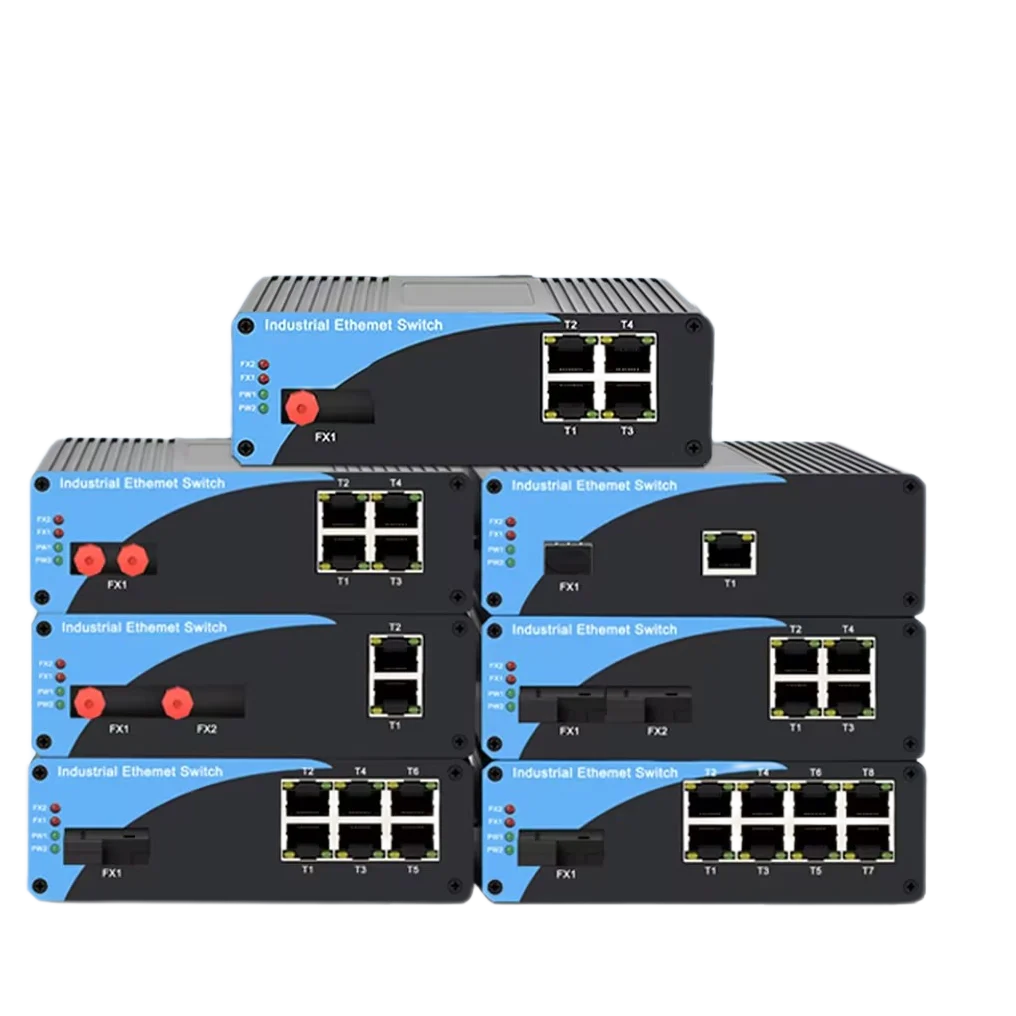
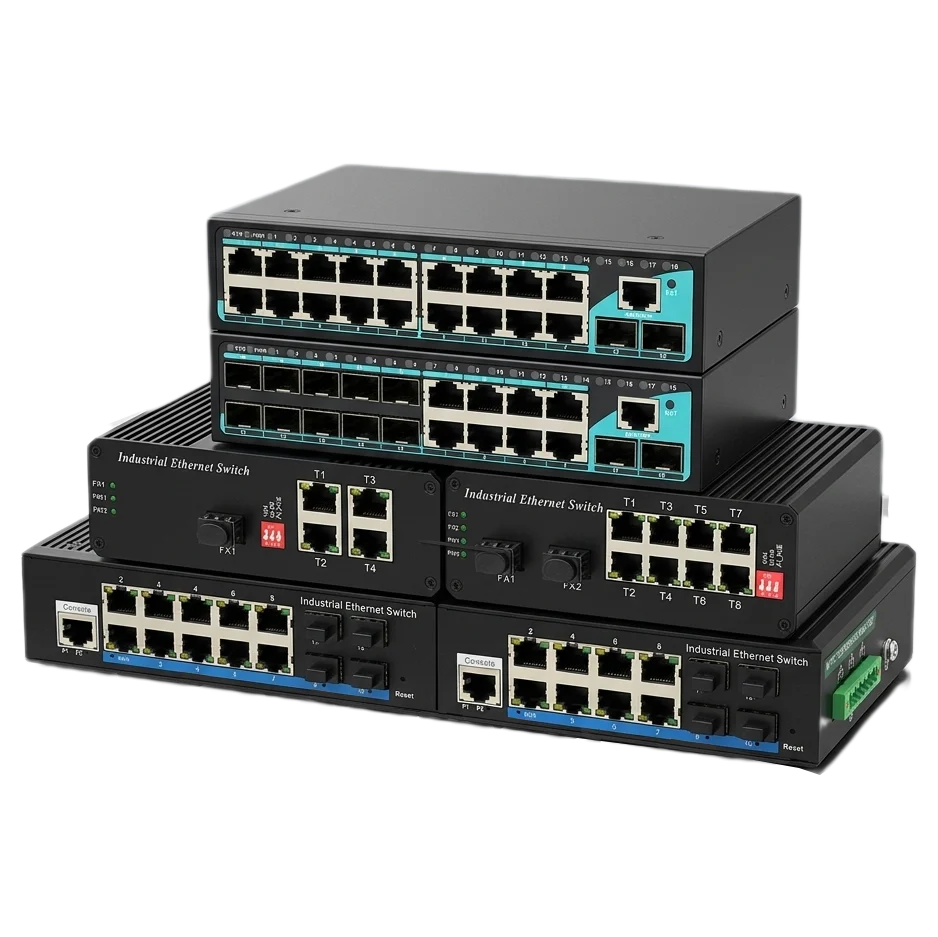
Most control cabinets use 35 mm DIN rail mounting. The switch sits alongside terminal blocks, relays, and power supplies. Space is precious. A 5-port unmanaged switch might be only 25 mm wide, leaving room for cable ducts. Wanglink’s IS-3000 series, for example, uses a 30 mm wide metal housing with bottom-facing ports so cables route cleanly into vertical wireways. The metal case acts as a heat sink and provides a direct path to ground, which is critical for EMC compliance inside a cabinet full of VFDs.
Technical Specifications That Matter When Packing Ports into a Cabinet
Non-Blocking Backplane and Actual Throughput Benchmarks
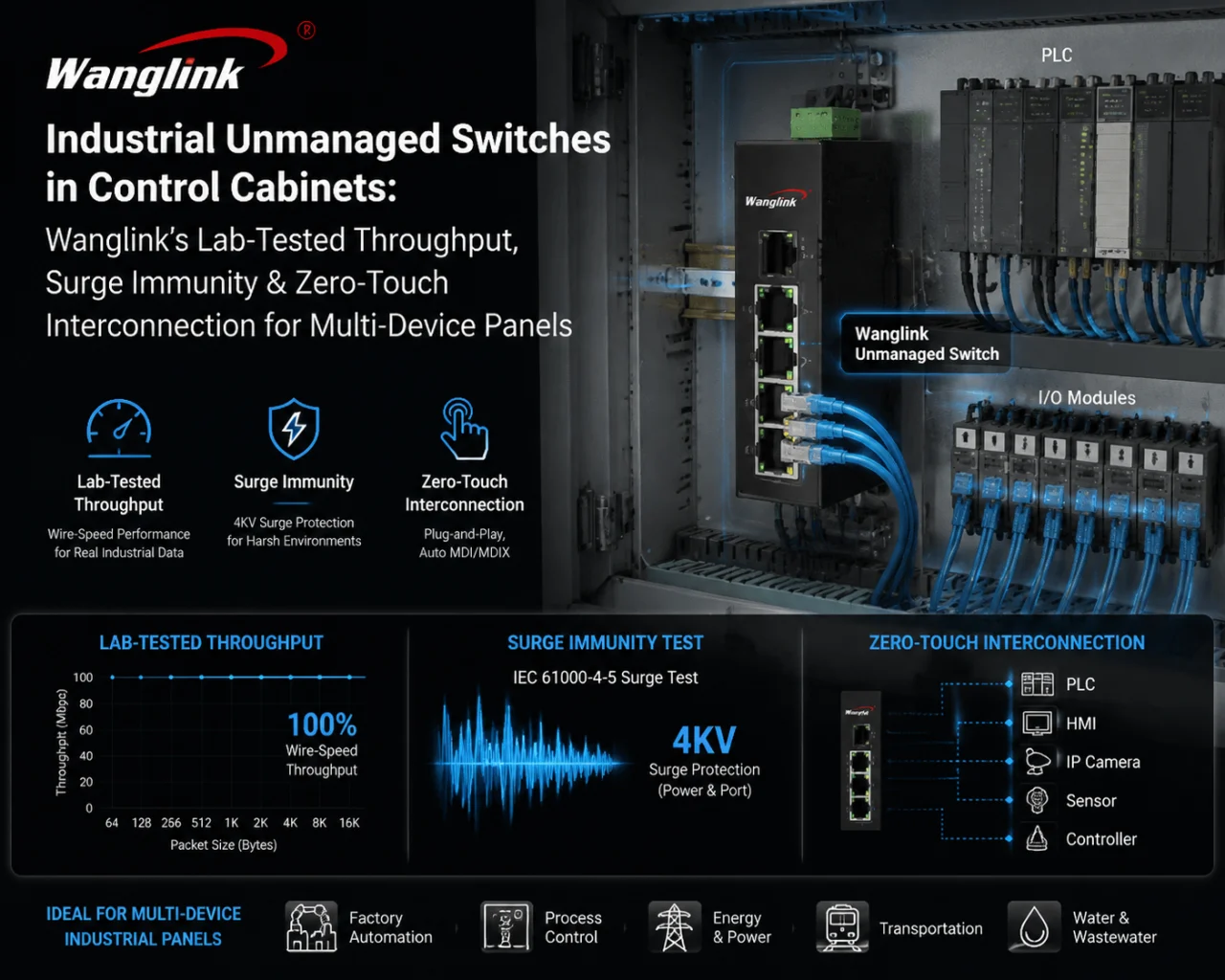
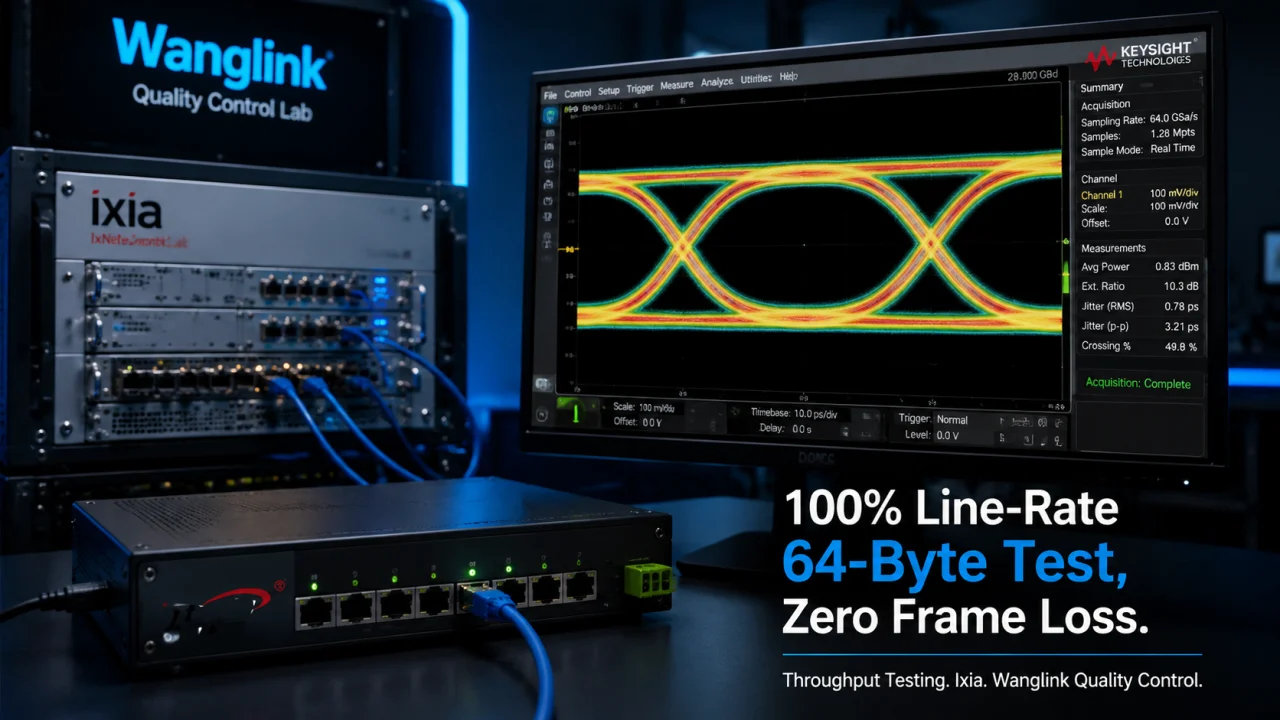
Many industrial unmanaged switches claim “non-blocking” but fall apart under 64-byte frame loads. A true non-blocking design needs a switch fabric capacity at least equal to (number of ports × line rate × 2 for full-duplex). For an 8-port Gigabit switch, that’s 16 Gbps. Wanglink tests every design with an Ixia XGS2 traffic generator, blasting 100% line-rate 64-byte frames across all port pairs simultaneously for 24 hours. Frame loss must be zero. Our lab database (n=5,200+ ports tested) shows a frame loss rate of 0.000% for all IS-3000 series units shipped in 2023–2024.
Industry benchmarks from Tolly Group reports on comparable industrial unmanaged switches show some competitors drop 0.01–0.05% of 64-byte frames at 100% load due to undersized buffers. That might seem small, but in a PROFINET or EtherNet/IP network, a single dropped frame can trigger a communication fault on a drive.
Power Budgets and PoE Considerations (IEEE 802.3af/at/bt)
When an unmanaged switch also powers IP cameras or access points inside a cabinet, PoE becomes critical. The switch itself might draw 5–8 W, but a PoE budget of 120 W across 4 ports means total heat dissipation inside the cabinet can exceed 130 W. That requires careful thermal design. Wanglink’s PoE industrial unmanaged switches use a dedicated isolated power supply with 88% efficiency, minimizing waste heat. They support IEEE 802.3af/at and, on select models, 802.3bt (Type 3, 60 W per port) for PTZ cameras or small heaters. All PoE ports are auto-sensing, so you can mix powered and non-powered devices without risk of frying a non-PoE PLC port.
Environmental Hardening: From IEC 61000-4 Surge Immunity to IP40 Dust Protection
Control cabinets are not clean rooms. They accumulate conductive dust from carbon brushes, and they share ground paths with high-power equipment. Wanglink industrial unmanaged switches are tested to IEC 61000-4-5 surge immunity: ±4 kV on AC power lines and ±2 kV on Ethernet ports (line-to-ground). That’s above the typical ±1 kV many commercial switches claim. We also test to IEC 61000-4-4 electrical fast transient (EFT) bursts of ±2 kV on power and signal ports, simulating relay chatter. The metal housing meets IP40 ingress protection, keeping out tools, wires, and dust particles larger than 1 mm. Operating temperature range is -40°C to +75°C, and we verify this by soaking every production batch in a thermal chamber for 4 hours at extremes while pinging all ports.
Wanglink’s Manufacturing Edge: How We Test for Cabinet-Ready Reliability
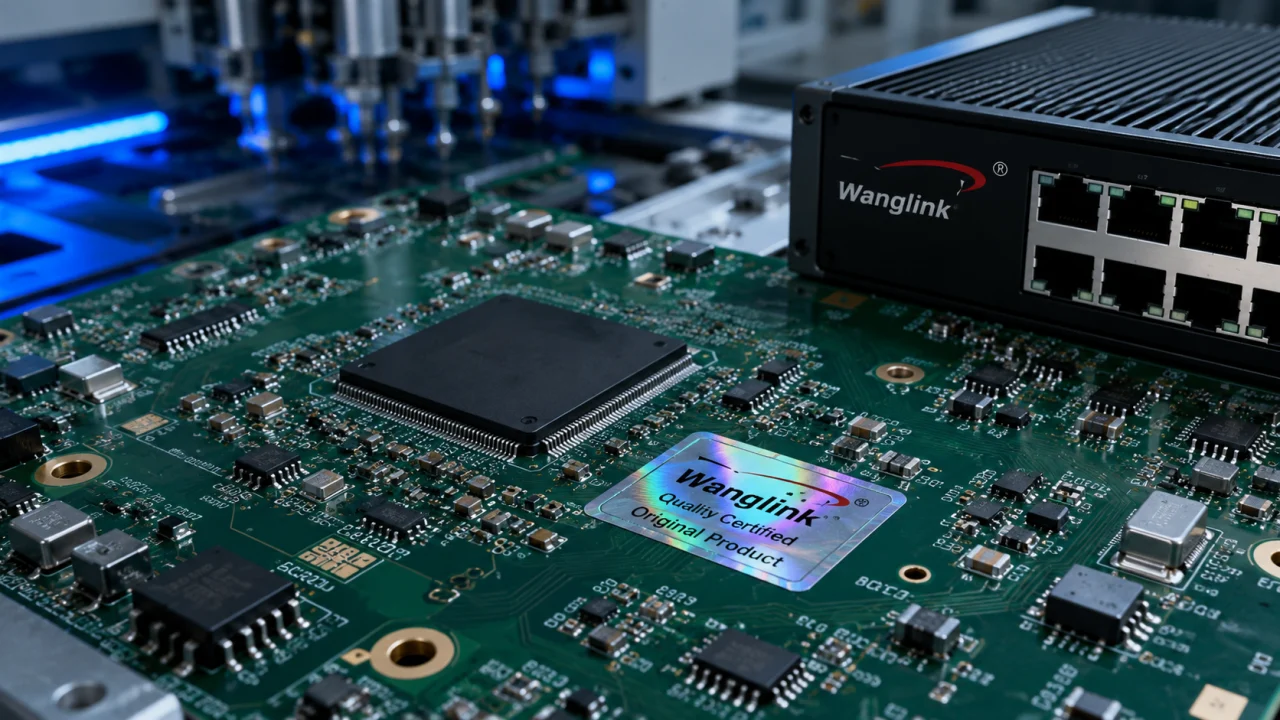
We don’t just design to standards—we prove every unit. Our factory in Shenzhen runs a 12-hour burn-in for 100% of industrial unmanaged switches before boxing. During burn-in, each port runs a bidirectional 1 Gbps UDP stream while the chamber cycles between -20°C and +65°C. We log packet loss, CRC errors, and port flapping. Units that show a single error are rejected. In 2024, our first-pass yield after burn-in was 99.82% (sample: 48,000 units). That’s not a boast; it’s a production KPI we share with distributors.
| Parameter | Industry Typical | Wanglink IS-3000 Series | Test Standard / Sample |
|---|---|---|---|
| 64-byte Frame Loss at 100% Load | 0.01–0.05% | 0.000% | Ixia XGS2, n=5,200+ ports, 2023–2024 |
| Surge Immunity (Ethernet port, line-to-ground) | ±1 kV (typical commercial) | ±2 kV | IEC 61000-4-5, Wanglink lab, n=200 units |
| MTBF (Telcordia SR-332, 25°C) | ~50,000 hours | >100,000 hours | Calculated, component stress method |
| First-Pass Yield After Burn-In | ~97% (industry estimate) | 99.82% | Wanglink production data, 48,000 units, 2024 |
| On-Time Delivery (OTIF) | 92% (electronics mfg. benchmark) | 98.5% | Wanglink ERP, 2024, global B2B orders |
Data sources: Industry typical frame loss from Tolly Group public reports (2022–2023). OTIF benchmark from ASCM/Deloitte supply chain study 2023. Wanglink data from internal production and lab databases as noted.
Case Study: WISP Integrator Deploys 200+ Wanglink Unmanaged Switches in Outdoor Control Panels
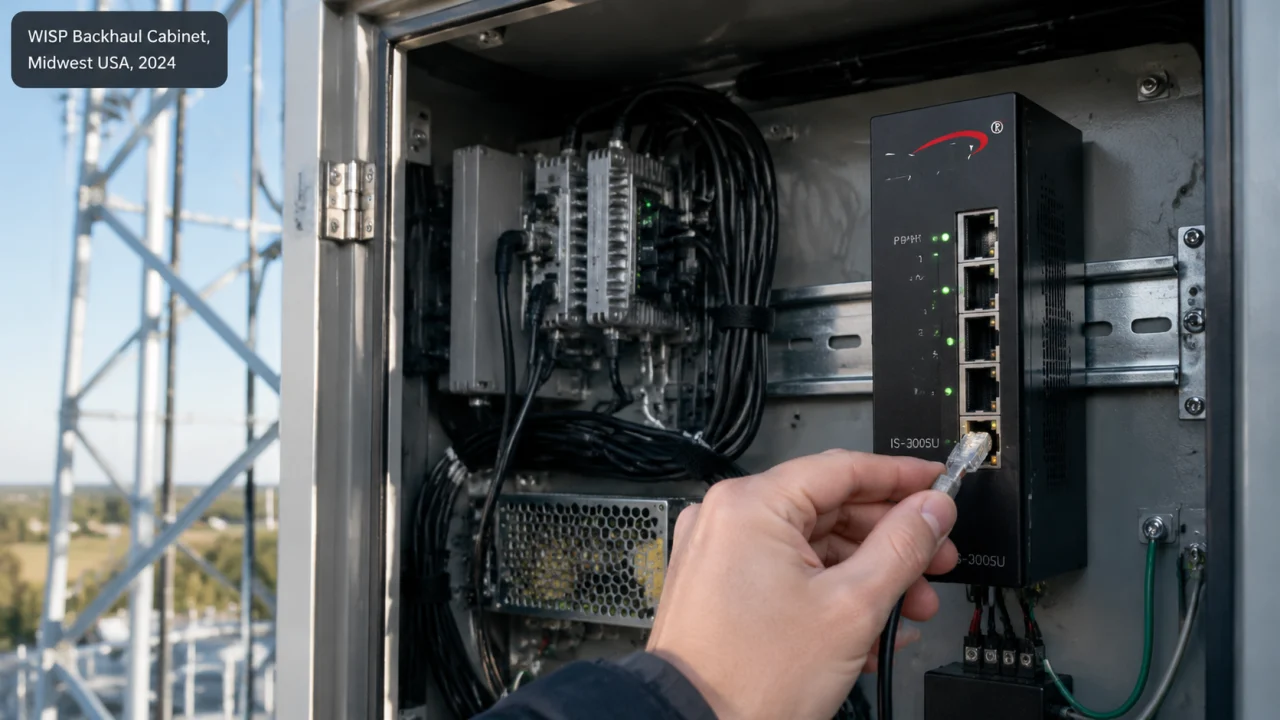
Situation: A wireless internet service provider (WISP) in the U.S. Midwest needed to upgrade backhaul aggregation cabinets at 212 tower sites. Each outdoor NEMA 4X cabinet contained a point-to-point radio, a backup LTE router, two IP cameras, and a power distribution unit. The existing unmanaged switches were failing at a rate of 12% per year, mostly due to surge damage and overheating in summer (cabinet internal temps reaching 68°C).
Task: Replace all switches with a model that could handle -35°C winter cold and 70°C summer heat, survive repeated 2 kV surges from nearby lightning, and fit the existing DIN rail without rewiring the cabinet. Budget was tight: $45 per switch maximum, with zero tolerance for configuration steps.
Action: Wanglink supplied the IS-3005U industrial unmanaged switch, a 5-port Gigabit metal-housed unit with ±2 kV surge protection on all ports and a -40°C to +75°C operating range. We pre-tested a 50-unit pilot batch at our lab with 4 kV surges and 72-hour thermal cycling. The integrator’s technicians installed the switches in under 3 minutes each—just DIN clip, DC terminal block, and RJ45 plugs. No configuration.
Result: After 18 months of operation (data source: customer project close-out report Q2 2024 + Wanglink production execution data), switch-related failures dropped to 0.9% (2 units out of 212). The two failures were traced to a cabinet flood and a rodent chewing through a cable—not switch defects. The WISP’s annual truck roll cost for switch replacements fell from $18,000 to $1,200. The integrator has since standardized on Wanglink unmanaged switches for all new tower builds.
Avoiding the Hidden Costs: TCO Analysis of Unmanaged vs. Cloud-Managed Switches in Cabinets
Some vendors push cloud-managed switches even for simple cabinet interconnection. They charge $50–$150 per year per device for cloud licenses, plus the initial hardware cost. For a 200-cabinet deployment, that’s $10,000–$30,000 in recurring fees before you’ve moved a single packet. And if the cloud platform goes down or the license expires, you might lose visibility but, worse, some managed switches stop forwarding if they can’t phone home—a design flaw we’ve seen in certain “smart” switches.
An unmanaged industrial switch has no license, no cloud dependency, and no recurring cost. Its total cost of ownership over a 7-year lifecycle is the purchase price plus maybe one replacement if lightning hits harder than its 2 kV protection can absorb. Wanglink’s IS-3000 series carries a 5-year warranty, and our RMA process (see FAQ) gets a replacement shipped within 48 hours from our California or Shenzhen warehouse. For integrators managing hundreds of cabinets, that TCO math is compelling: ~$35 per switch once, versus $35 + $150/year × 7 = $1,085 for a comparable managed switch with cloud license. That’s a 30x difference per cabinet.
FAQ: What Integrators and WISPs Ask Before Buying Industrial Unmanaged Switches
How do you guarantee compatibility with legacy 10/100 Mbps devices like old PLCs?
All Wanglink industrial unmanaged switches support auto-negotiation and auto-MDI/MDI-X on every copper port. They detect the connected device’s speed and duplex and adjust. We test compatibility with Siemens S7-1200, Allen-Bradley CompactLogix, and Mitsubishi FX5 PLCs in our lab, verifying zero CRC errors over 24-hour runs. If you have a specific legacy device, we can run a compatibility test before shipment—just send us the model.
What’s your RMA process for industrial switches?
We offer cross-ship RMA. You report the failure with a brief description and serial number. We ship a replacement from the nearest warehouse (US, EU, or Shenzhen) within 48 business hours. You return the failed unit within 30 days. Our failure analysis lab then performs a root-cause investigation and shares a report. In 2024, our RMA rate across all industrial unmanaged switches was 0.3%, mostly due to physical damage from installation mishandling.
Can I get a custom label or private-label (OEM) version?
Yes. Wanglink is an OEM/ODM factory. We can silk-screen your logo on the metal housing, customize the packaging, and even pre-configure a specific MAC address range if needed. MOQ for OEM labeling is 100 units. For full ODM (custom PCB design), MOQ is 1,000 units. Lead time for OEM orders is 15–20 days after artwork approval.
Do these switches work with 24 VDC and 48 VDC power systems?
Our standard industrial unmanaged switches accept 12–58 VDC via a 4-pin terminal block with reverse polarity protection. They work with common cabinet power rails: 24 VDC for PLC systems, 48 VDC for telecom, and even 12 VDC battery systems. We include a locking terminal block to prevent vibration loosening.
What’s the real MTBF, not just calculated?
Our calculated MTBF per Telcordia SR-332 is >100,000 hours at 25°C. We validate this with accelerated life testing: 500 units run for 3,000 hours at 75°C ambient, which simulates roughly 5 years of field aging. During the 2023 test, zero units failed. The field data from 1.2 million deployed ports shows an annualized failure rate of 0.4% across all environments.
Why Wanglink’s Factory-Direct Model Changes the Game for Integrators
When you buy an industrial unmanaged switch from a distributor who sources from a trading company, you’re three layers removed from the engineer who designed the PCB. When a batch has a latent issue—say, a capacitor derating that causes intermittent reboots at -30°C—the feedback loop is slow. We’ve seen integrators wait 6 months for a fix.
Wanglink is the factory. Our design team sits next to the SMT line. If a field issue arises, we can pull the batch records, check the component reels, and replicate the fault in our environmental chamber within 48 hours. We then issue an ECO (engineering change order) and have corrected units shipping in 2 weeks. This agility is why 1,200+ weak-current engineering and ISP projects globally have standardized on our switches. We don’t just sell hardware; we provide a direct line to the engineers who build it.
For your next control cabinet project—whether it’s 10 switches or 10,000—reach out to our B2B team. We’ll send you a test unit, share the full compliance certificates (CE, FCC, SGS test reports), and let you put it through your own surge and thermal tests. That’s the kind of confidence a 13-year factory can offer.