Project Overview
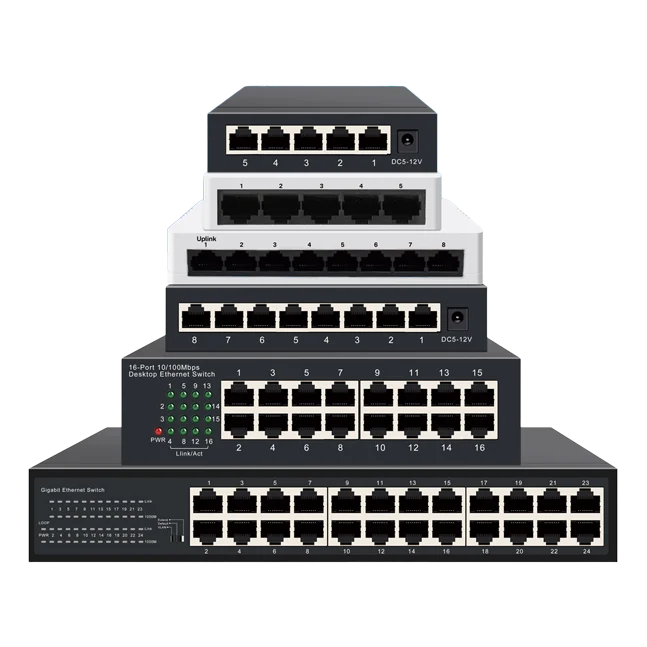
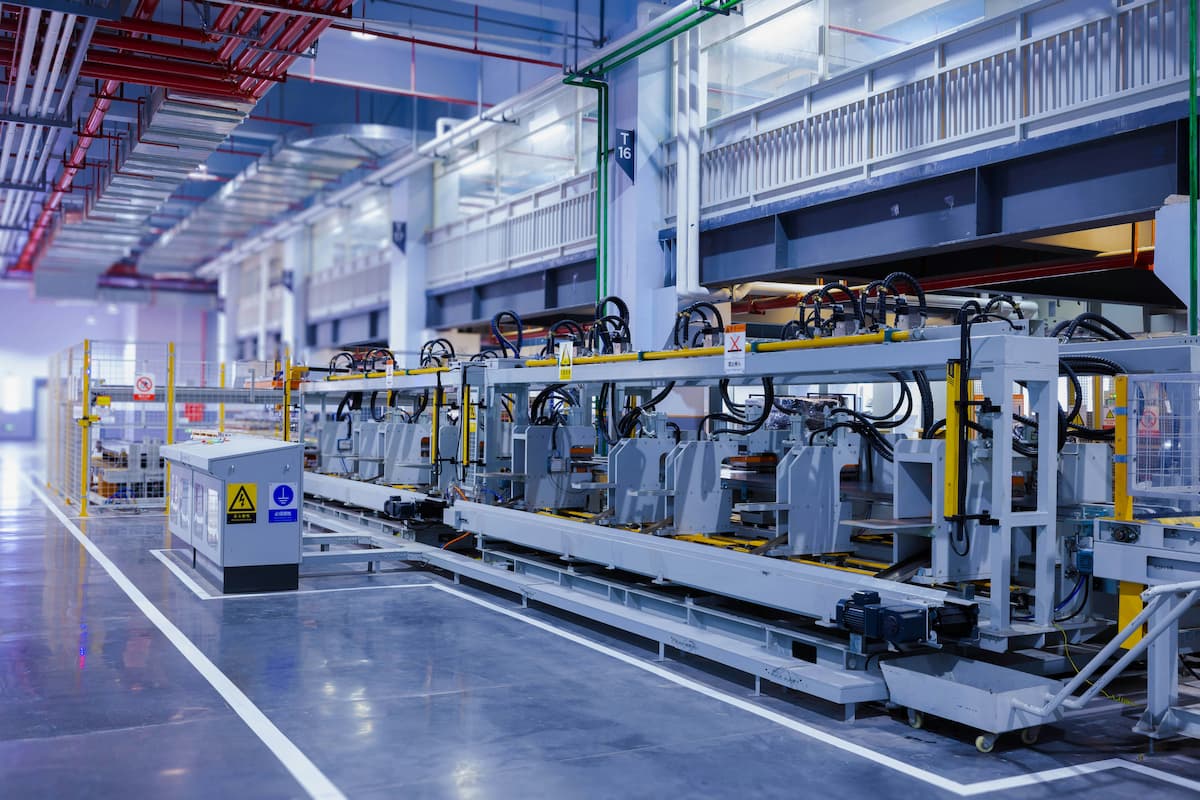
A mid-sized precision manufacturing enterprise operates a 24/7 production campus spanning three workshop buildings, a warehouse, and an administration office. Over 200 IP cameras, access control nodes, and environmental sensors were originally deployed on a single flat 192.168.0.0/16 network using unmanaged switches. The client required logical segmentation into Office (192.168.1.0/24), Surveillance (192.168.2.0/24), and Facility Management (192.168.3.0/24) subnets while maintaining cross-subnet communication — without replacing the existing cabling or unmanaged edge switches. Our team delivered a non-disruptive migration using a Layer 3 core switch, PoE-powered access switches for critical camera clusters, and fiber optic uplinks to guarantee reliable, high-bandwidth transmission across buildings.

Original System Pain Points & Upgrade Necessity
- Broadcast storm vulnerability: All devices — office PCs, IP cameras, NVRs, BACnet controllers — shared a single oversized broadcast domain, causing intermittent latency spikes during peak hours.
- No traffic isolation: A malware outbreak on one office workstation could flood the entire network, including safety-critical surveillance streams.
- Manual IP management chaos: Overlapping static IP assignments were frequent, leading to address conflicts that took hours to trace due to unlabeled ports and zero documentation.
- Power delivery gaps: New 4K PTZ cameras required PoE+ which existing desktop switches could not supply, forcing unreliable power injectors at multiple locations.
- Inter-building bandwidth bottlenecks: Legacy copper backbones between workshops suffered from electromagnetic interference, causing packet loss and frame tearing on recorded footage.

Core Project Requirements
| Requirement Domain | Specification |
|---|---|
| Logical Segmentation | Three isolated subnets with controlled inter-VLAN routing at wire speed |
| Zero-Touch Edge Migration | Retain existing unmanaged switches and cabling; avoid re-patching to meet tight downtime window |
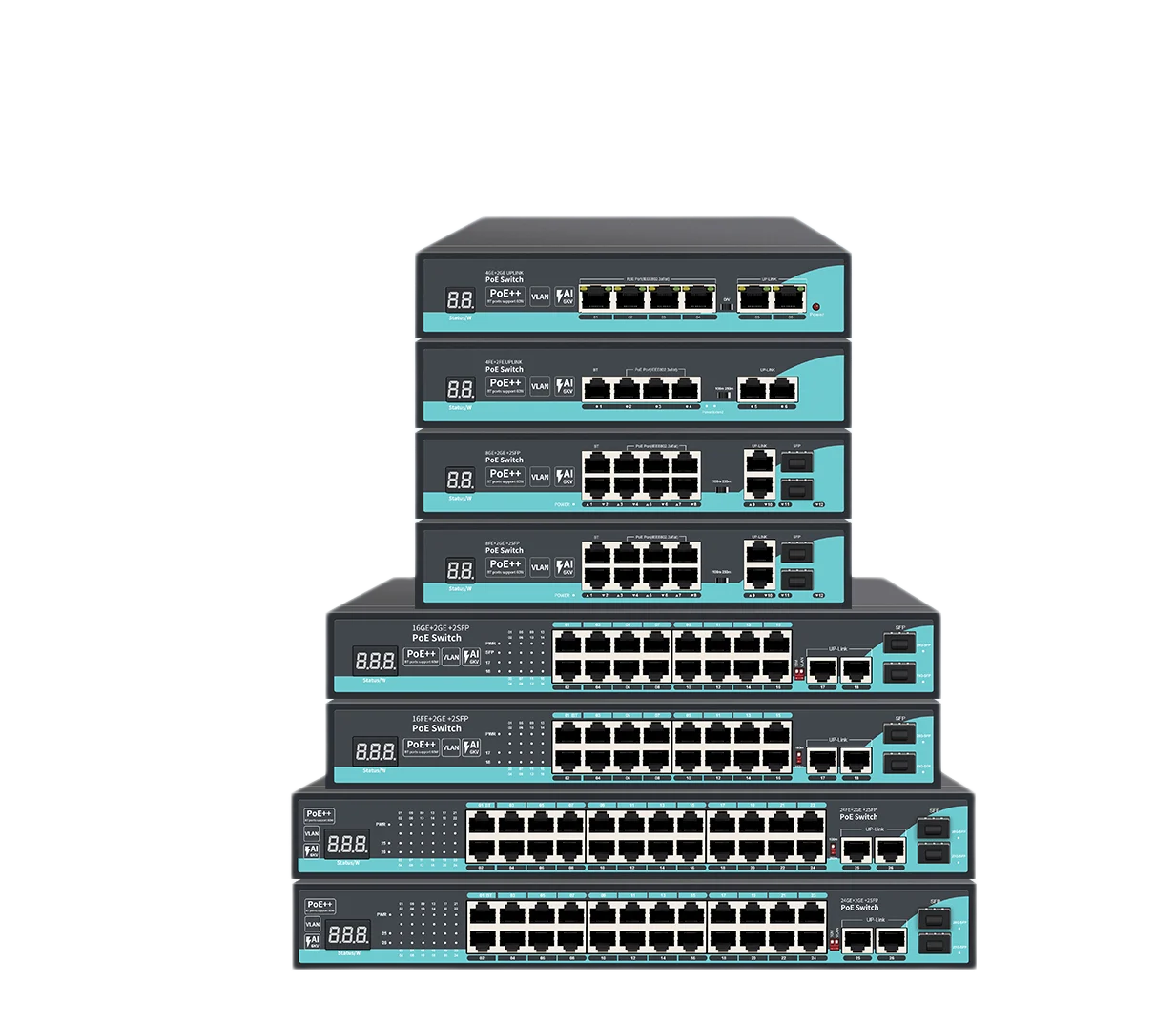
| Power over Ethernet | 802.3at (PoE+) for 45 new 4K outdoor cameras; centralized power budget management |
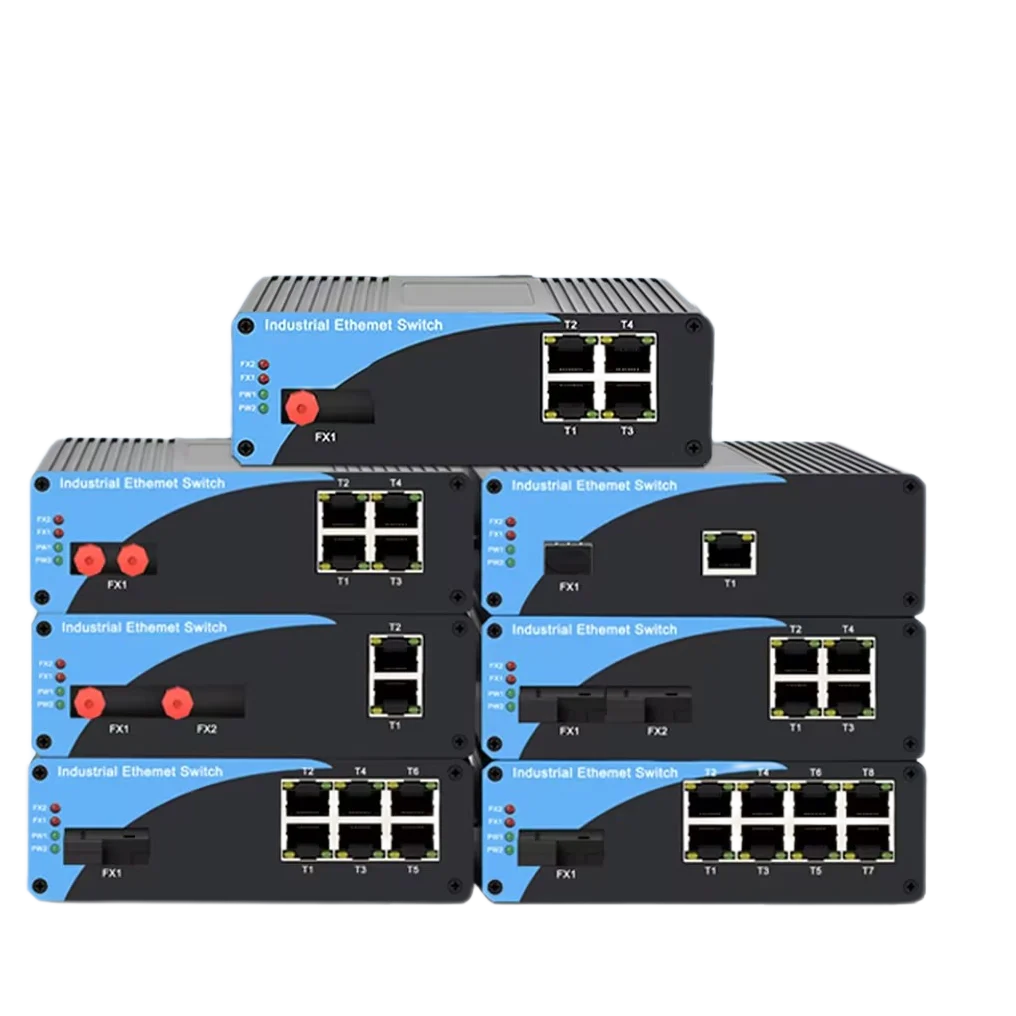
| Inter-Building Connectivity | Fiber optic backbone (Single-Mode) with redundant links between workshop buildings |
| Centralized Management | Unified monitoring dashboard for switch health, PoE consumption, and link status |
| Stability Under Load | Non-blocking throughput for 128-channel NVR recording at 4K resolution, 24/7 |
Customized Network & PoE Group Solution
The design introduced a Layer 3 aggregation switch as the new intelligent core. Because the edge infrastructure could not be VLAN-tagged, all access layer traffic arrives untagged at the core. On a single VLAN interface, multiple secondary IP addresses were configured to act as the default gateways for each IP subnet. Layer 3 routing between these sub-interfaces enables controlled cross-subnet communication without altering the existing broadcast domain. This technique delivered immediate logical separation at the IP layer while preserving full wire-speed forwarding between Office, Surveillance, and Facility Management segments.
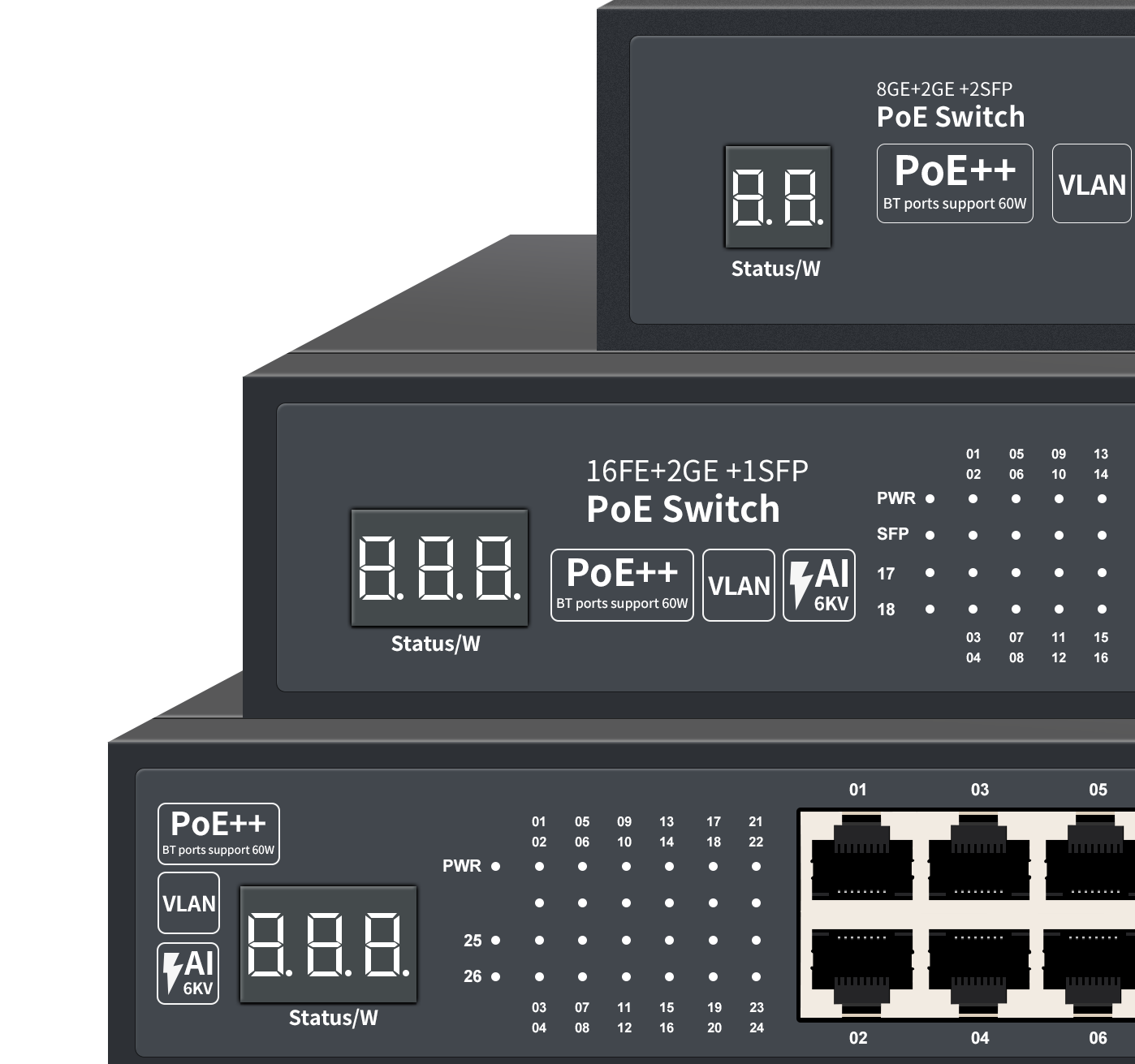
New PoE+ managed switches were installed at strategic points: one per workshop and one in the new outdoor camera cluster zone. These switches connect back to the core via 10G SFP+ fiber modules, replacing noisy copper links. Fiber transceivers and pre-terminated single-mode cables ensure interference-free, long-distance backhaul. All PoE ports are monitored via a centralized cloud management platform, enabling real-time power cycling and health alerts.

Core Equipment Applied
| Device Role | Model Category | Key Capability |
|---|---|---|
| Layer 3 Core Switch | Enterprise Modular Routing Switch | Multiple secondary IPs on VLAN interface, hardware-based inter-VLAN routing, dual redundant power supplies |
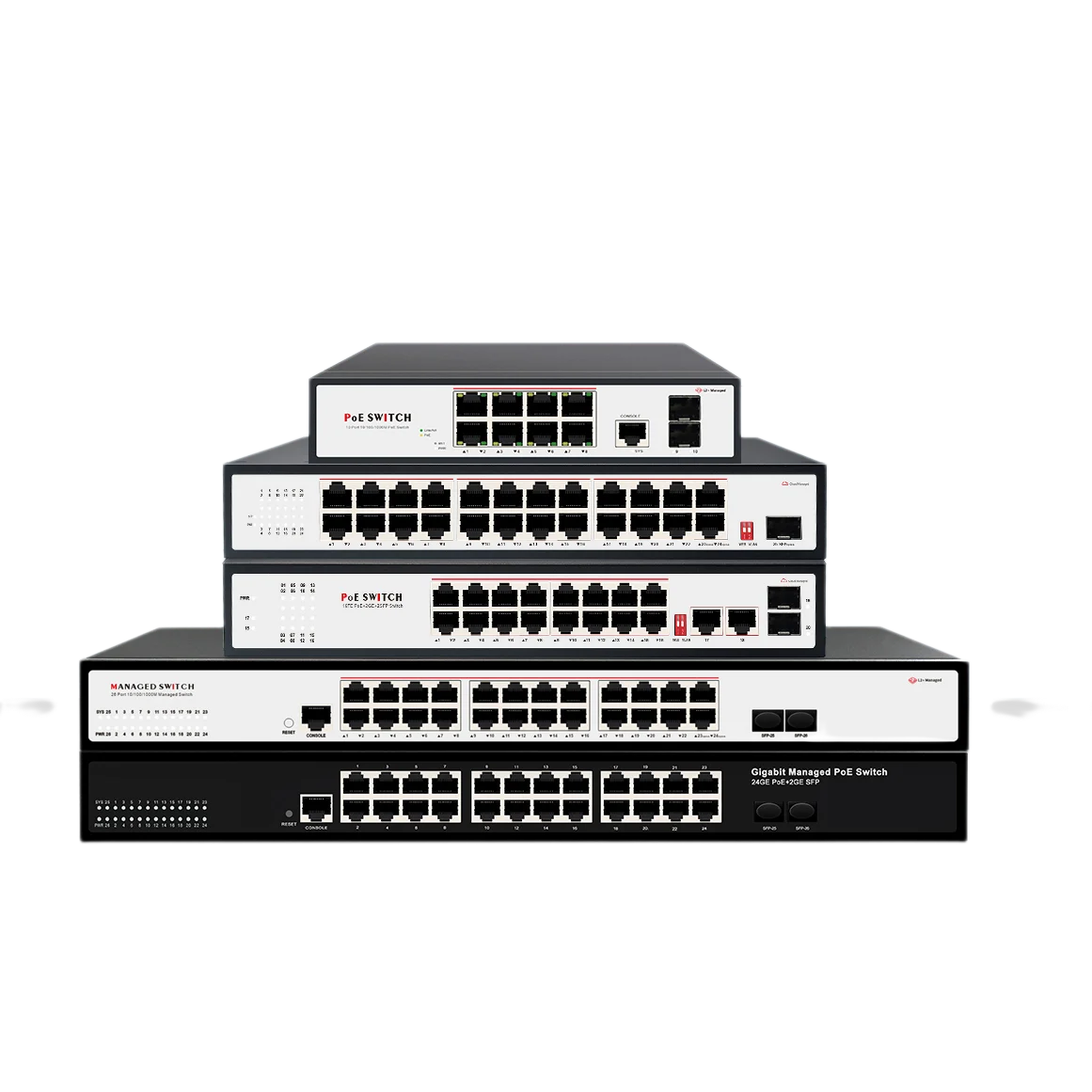
| PoE Access Switch | 24-Port Gigabit L2+ Managed PoE+ Switch (370W) | 802.3at up to 30W per port, fiber uplink SFP slots, auto-surveillance VLAN, remote power scheduling |
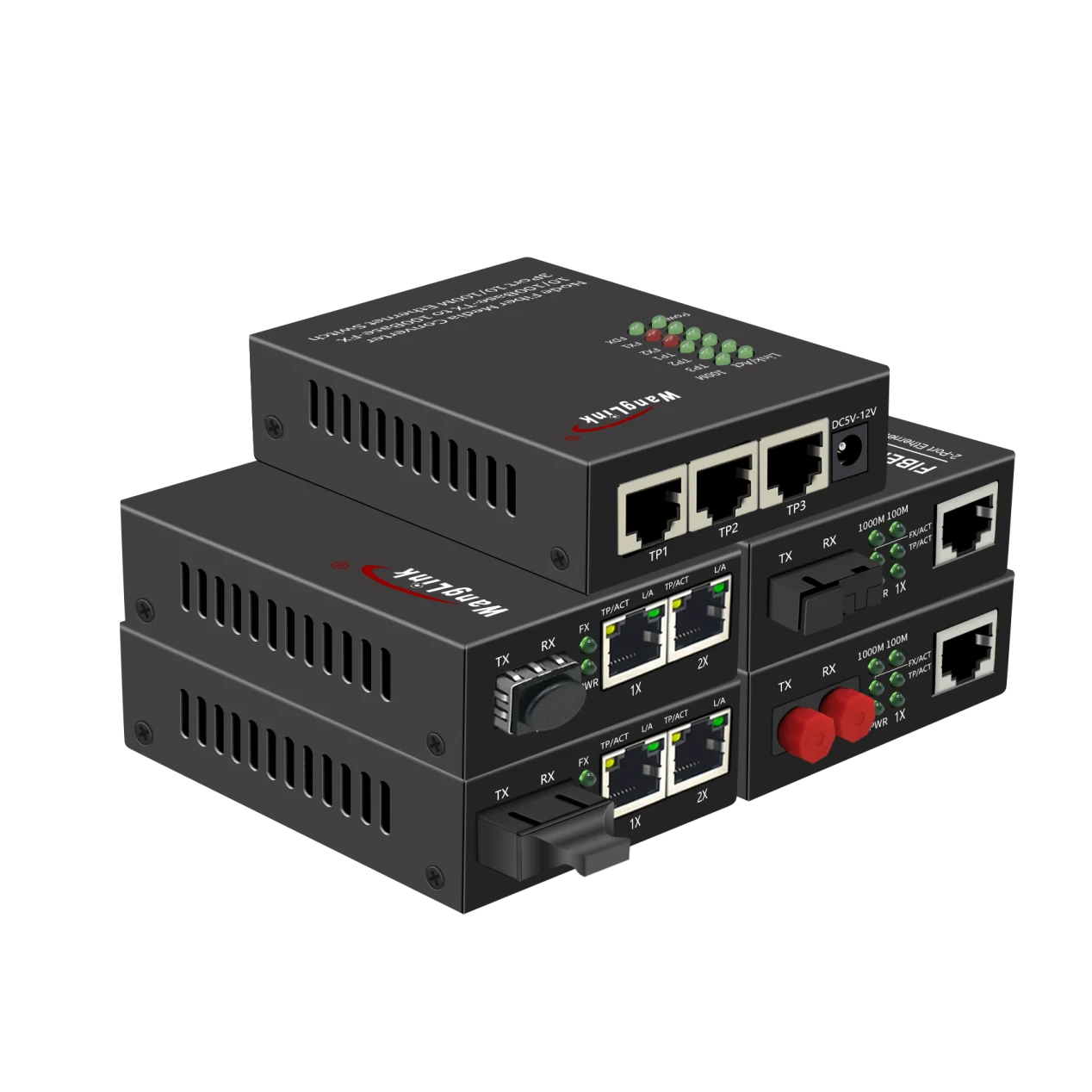
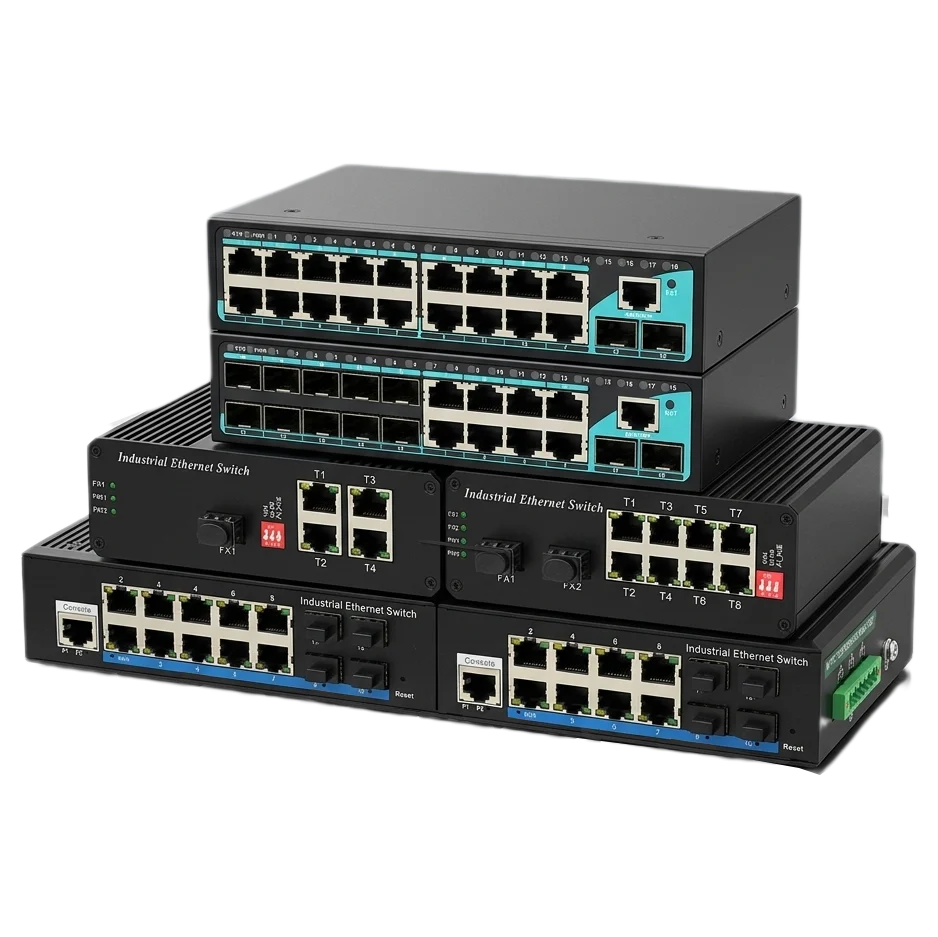
| Fiber Transceivers | 10G SFP+ Single-Mode (10km) | Industrial temperature range, bidirectional LC connectors, low latency |
| Centralized Controller | Cloud Network Management Platform | Unified visibility of all switches, PoE power budget dashboards, topology auto-discovery |
| NVR & Storage | 128-Channel RAID NVR with dual 10G uplinks | 4K sustained recording, AI-based motion detection analytics |
Key Design Highlights
- Non-disruptive overlay routing: Achieved full IP subnetting by injecting a single intelligent core, leaving 150+ edge devices untouched — zero downtime for production lines.
- Hybrid fiber-PoE architecture: Combine the robustness of single-mode fiber for inter-building links with the simplicity of PoE for camera deployment, eliminating separate power circuits.
- Multi-subnet gateway on one interface: Enabled by secondary IP configuration, effectively turning a flat Layer 2 domain into a routed environment without VLAN tagging.
- Power visibility & control: Per-port PoE consumption graphs allow facility managers to preemptively identify failing cameras based on power anomalies.
- Bandwidth assurance: 10G fiber uplinks guarantee that forty 4K cameras at each workshop stream without compression artifacts, even during simultaneous NVR playback and remote access.

Product Core Technical Advantages
Stable PoE Power Delivery
- Intelligent power management with overload protection and priority-based allocation prevents camera dropouts during boot surges.
- Continuous 370W budget with active thermal design ensures 24/7 operation at ambient temperatures up to 55°C.
Fiber-Based Transmission Resilience
- Industrial-grade SFP+ modules withstand electromagnetic interference from heavy machinery, delivering error-free 10G links up to 10 km.
- Bi-directional optical monitoring sends early warnings on signal degradation, enabling proactive maintenance before packet loss occurs.
Centralized Simplicity
- Zero-touch provisioning for PoE switches: new units automatically inherit configuration profiles when connected to the core.
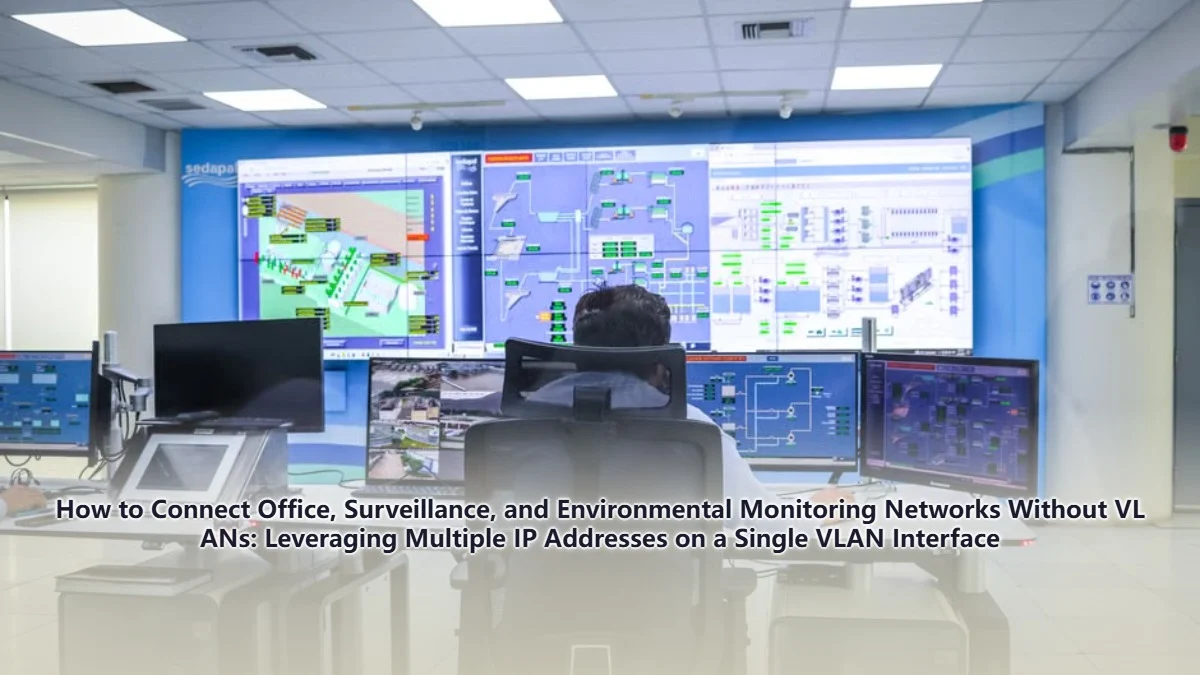
- Single-pane-of-glass dashboard displays every switch, camera link status, and PoE health, dramatically reducing mean time to repair.

Project Outcomes & Industry Value
The full migration was completed within a 4-hour scheduled maintenance window without a single production stoppage. Post-upgrade metrics demonstrated a 73% reduction in latency for surveillance streams, zero address conflicts over six months, and a 40% faster incident response time due to centralized fault visualization. The hybrid model — combining a Layer 3 overlay with managed PoE access and fiber backbone — proved that legacy infrastructure does not have to be entirely replaced to achieve enterprise-grade segmentation and reliability. This approach is directly replicable across logistics parks, municipal traffic monitoring, educational campuses, and water treatment facilities where brownfield sites demand evolution without upheaval.
| Metric | Before | After |
|---|---|---|
| Surveillance stream latency | 85ms avg | 23ms avg |
| Address conflict incidents / month | 12 | 0 |
| PoE deployment time per camera | 2.5 hours (power injector) | 20 minutes (PoE switch) |
| Network-related downtime / year | 47 hours | 3 hours |
| Energy efficiency (PoE scheduling) | N/A | 18% power saved off-hours |
“We finally have clear separation between office and production traffic without touching a single camera’s IP. The PoE switches with fiber made our new high-resolution cameras plug-and-play. Management is now a one-screen task.” — Facility IT Lead