
Executive Summary (TL;DR)
- Industry: Urban rail transit — wayside signaling, onboard and station networks
- Deployment Scale: Typical lines of 10–25 stations and 15–30 trainsets, with tens of wayside cabinets and an onboard switch set per train
- Products Implemented: IS700-12E4F, IS700-16E8F, IS730-12E4F (10G uplink backbone), IS830-12E4F-B (Layer 3 at the core)
- Core Results: Engineered for continuous operation, mechanical vibration, -40 °C to +75 °C temperature extremes and fast ring recovery across the line
1. Project Background & Technical Challenges
A metro line is really two networks in one. Along the tracks, signaling interlockings, trackside cameras, passenger information displays and platform access equipment sit in wayside cabinets exposed to vibration from passing trains, temperature swings in tunnels and strong traction-related EMC. On the trains themselves, onboard CCTV, passenger information systems, condition monitoring and train-control interfaces must keep talking while the carriage is constantly moving. Both halves demand near-zero tolerance for link loss: a signaling outage is a safety event, and a dead passenger-information feed frustrates thousands of riders.
Typical engineering pain points for this class of project:
- Persistent mechanical vibration. Long-term low-amplitude vibration works connectors and solder joints loose, so office-grade or fan-cooled hardware is a poor fit for both trackside cabinets and carriage-mounted equipment.
- -40 °C to +75 °C temperature extremes. Tunnels, station platforms and rooftop equipment rooms can swing from freezing to well above ambient; hardware must stay within a wide operating envelope.
- Strict EMC in the railway environment. Traction power, regenerative braking and signaling systems generate intense interference. EN 50155 (rolling stock) and EN 50121 (railway EMC) are the usual tender requirements, treated here as project design targets rather than pre-claimed certification.
- Uninterrupted connectivity for critical systems. Ring or meshed topologies are expected to recover within milliseconds so that signaling, CCTV and passenger information keep running through a single cable fault.
2. The Network Architecture & Solution Design
The architecture is built around ring-protected access with a 10G-aggregated backbone. Wayside cabinets along the line each host a rugged DIN-rail industrial managed switch that collects local signaling, camera and platform devices and joins a fiber ring running the length of the line. Carriages carry their own onboard switches, linked along the train within the same fault-tolerant design so a single link loss does not isolate a car. At stations and the control center, Layer 3 managed switches aggregate the rings, route between the wayside, station and onboard domains, and hand traffic up to a 10G SFP+ backbone that carries combined video, signaling and passenger information without congestion. The managed Layer 2+ switches are chosen specifically for their ring support: ERPS (Ethernet Ring Protection Switching) lets a broken fiber heal automatically, which is the core requirement for continuous signaling and CCTV.
Key Technical Implementation Details
- ERPS ring protection on every segment. Wayside rings and onboard links are designed for fast recovery — project targets are commonly set below 50 ms and, on some configurations, below 20 ms, with actual recovery depending on the model, ring size and configuration.
- Vibration-tolerant, DIN-rail mounting. Rugged fanless metal housings and secure DIN-rail mounting reduce the effect of continuous train-induced vibration in both cabinets and carriages.
- Wide DC input for rail supplies. Wide-range DC input on selected models is intended to tolerate the supply fluctuations encountered on rolling-stock and trackside power; fiber spans also remove copper’s distance limits and susceptibility to traction EMC.
- Layer 3 segmentation at the core. Inter-VLAN routing separates signaling, CCTV and passenger-information traffic at the station and control-center level for predictable performance.
3. Why Wanglink Switches Were Selected
| Engineering Requirement | Standard Commercial Switch | Wanglink Industrial Switch | B2B Value & Impact |
| Mechanical vibration | Office-grade housing | Rugged DIN-rail, vibration-tolerant design | Stable links on wayside and moving stock |
| Onboard supply range | Fixed 12 V / AC adapter | Wide-range DC input (depending on the model) | Tolerates rail power fluctuations |
| Ring recovery for signaling | No ring support | Managed ERPS ring with fast recovery | Signaling and CCTV survive a fiber break |
| EMC / railway standards | Basic EMC only | Designed for EN 50121-class EMC targets (selected models) | Helps meet tender EMC requirements |
| Aggregation bandwidth | 1G links only | 10G SFP+ uplink on IS730 | Headroom for video + passenger information |
| Layer 3 routing | Unmanaged / L2 only | L3 managed on IS830 | Inter-VLAN routing at the station edge |
4. Deployment Outcomes & Engineering Value
- Design goal: uninterrupted signaling and CCTV. ERPS ring protection across wayside and onboard segments is engineered so a single fiber fault is healed automatically rather than interrupting service.
- Typical deployments target sub-50 ms ring recovery, with some configurations targeting below 20 ms — actual results depend on ring size, model and configuration and should be validated during factory acceptance testing.
- Wider service-temperature envelope. A -40 °C to +75 °C design envelope on selected models is intended to cover tunnel, platform and rooftop equipment rooms within a single product family.
- Lower maintenance and a future-ready backbone. Fanless DIN-rail hardware with no moving parts reduces vibration-driven failures, while a 10G SFP+ aggregation layer adds headroom for new cameras and passenger-information streams without re-cabling the core.
5. Recommended Products in This Case
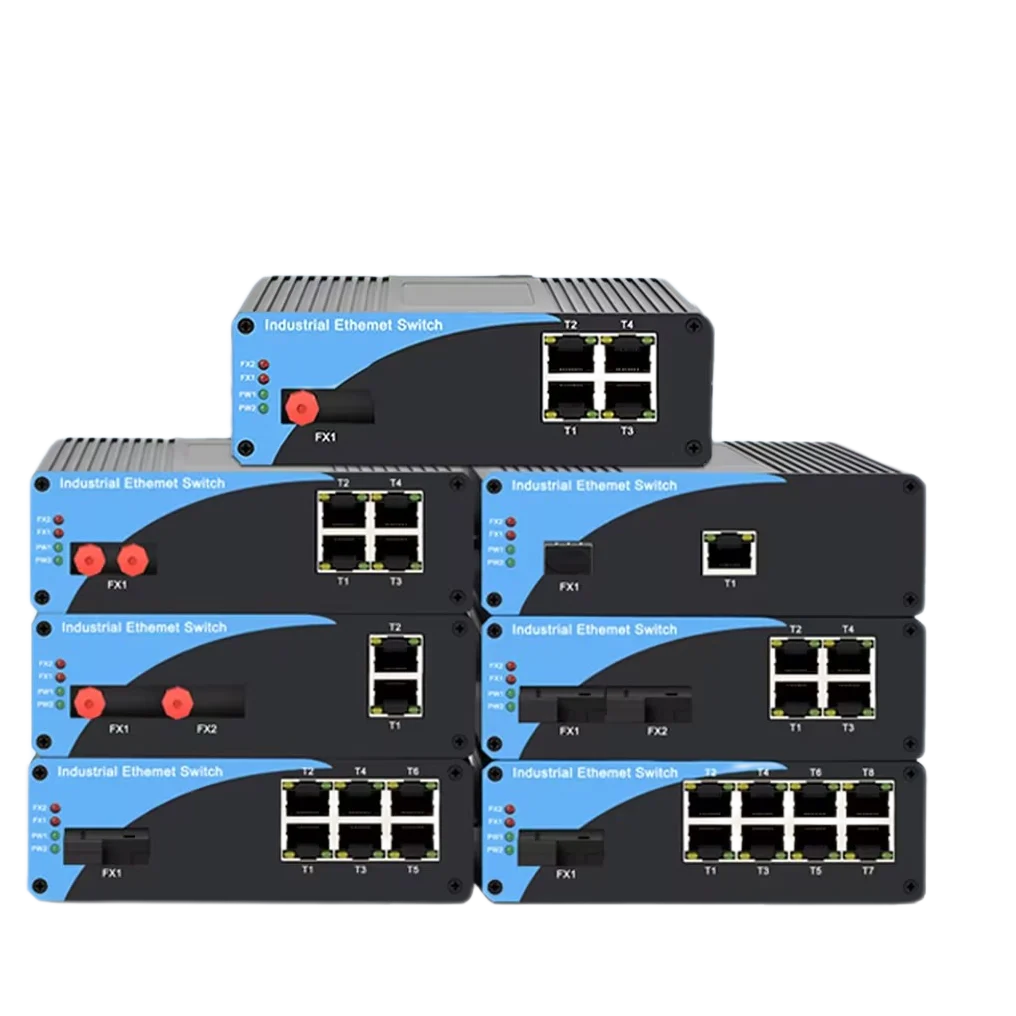
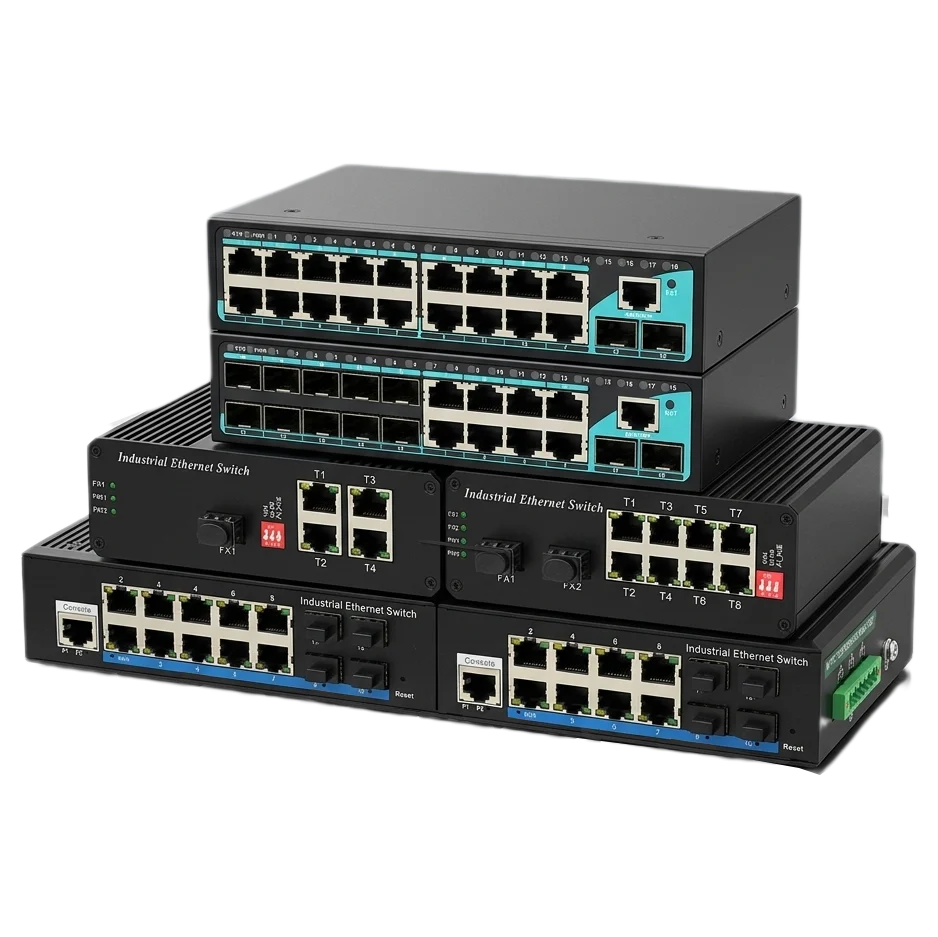
IS700-12E4F — Managed 12-Port Gigabit Industrial Ethernet Switch
- 12 × Gigabit RJ45 ports plus 4 × fiber uplinks
- Managed Layer 2+ with ERPS ring, VLAN, QoS and SNMP
- DIN-rail mounted, fanless metal housing for wayside cabinets
- Wide DC input and wide operating temperature on selected models
- Suited to platform and medium wayside-cabinet aggregation
IS700-16E8F — Managed 16-Port Full Gigabit Industrial Ethernet Switch
- 16 × Gigabit RJ45 ports plus 8 × fiber uplinks
- Higher-density aggregation for larger stations and interlockings
- Managed Layer 2+ with ring protection and traffic segmentation
- DIN-rail mounted with dual DC input (depending on the model)
- Wide operating temperature rating on selected models
IS730-12E4F — Managed Industrial L2 Switch with 10G SFP+ Uplink
- 12 × Gigabit access ports with 10G SFP+ uplinks for the backbone
- Managed Layer 2 with ring support and QoS for mixed video/signaling traffic
- Designed for line-level aggregation where 1G uplinks would bottleneck
- DIN-rail mounted, fanless metal housing
- Wide operating temperature rating on selected models
IS830-12E4F-B — Managed 12-Port Layer 3 Industrial Ethernet Switch
- 12 × Gigabit RJ45 ports plus 4 × fiber uplinks
- Layer 3 routing for inter-VLAN traffic between signaling, CCTV and PIS domains
- Managed feature set with ring support and advanced QoS
- DIN-rail mounted with redundant DC input (depending on the model)
- Wide operating temperature rating on selected models
Engineer a Rail Network Built to Keep Running
Specifying switches for a metro line, light-rail project or rolling-stock programme? Share your line topology, ring design and EMC targets, and our engineers will help you match ring-protected industrial switches with a 10G backbone to your tender requirements. Talk to our rail networking team.