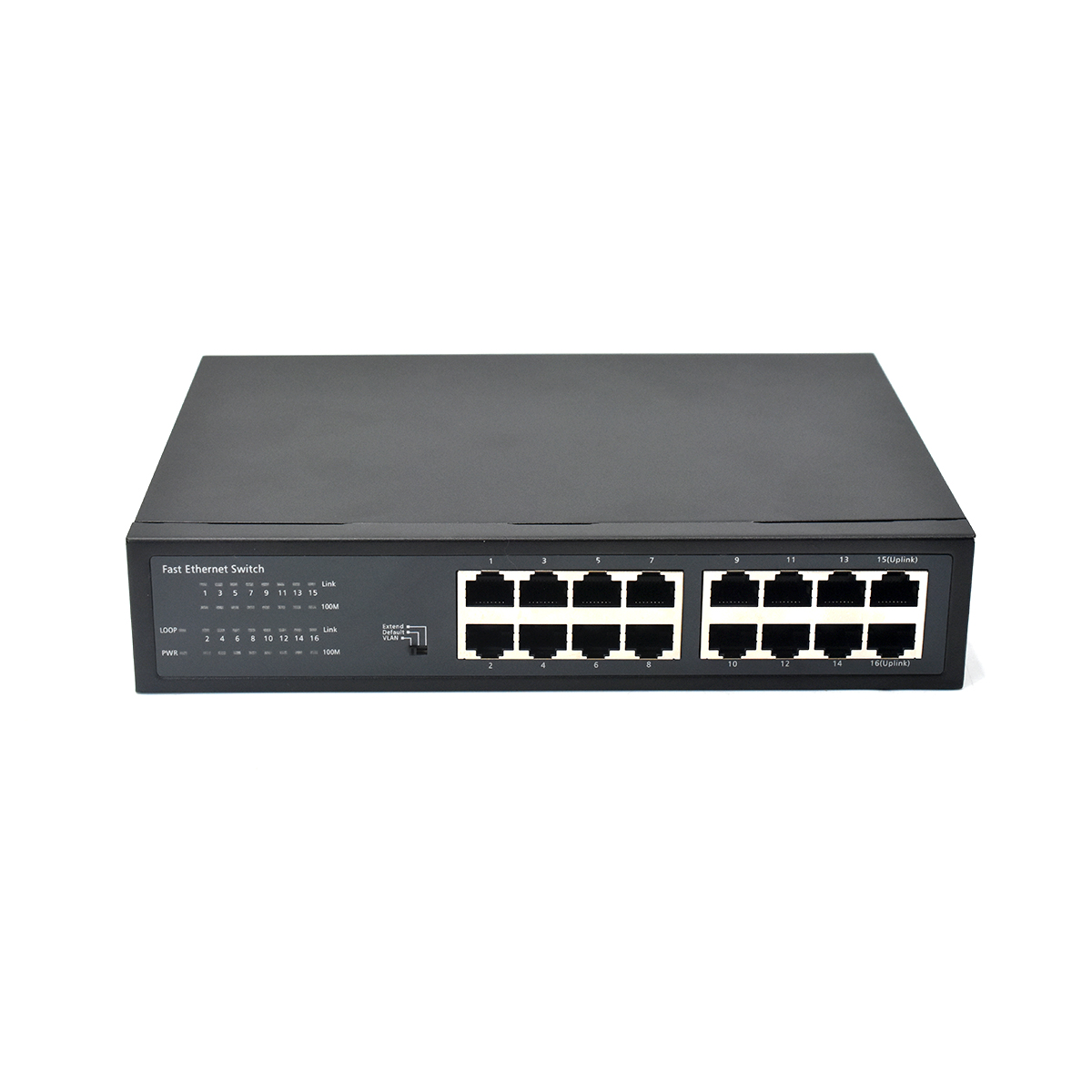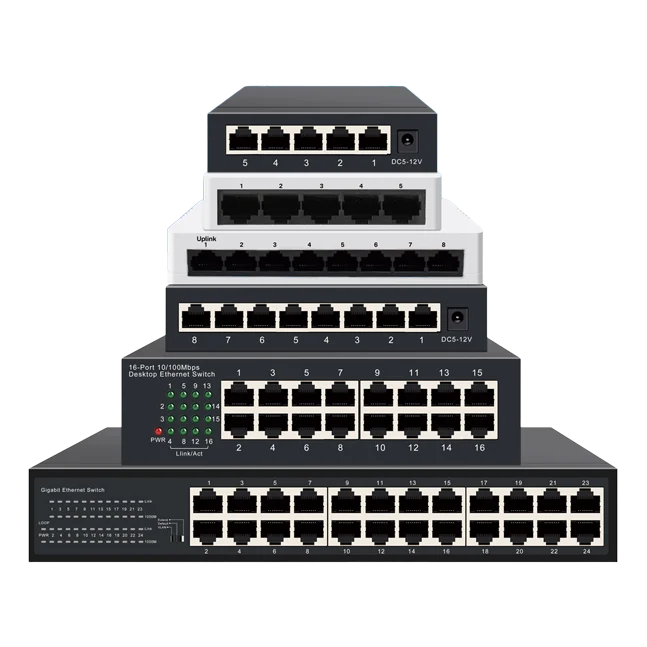
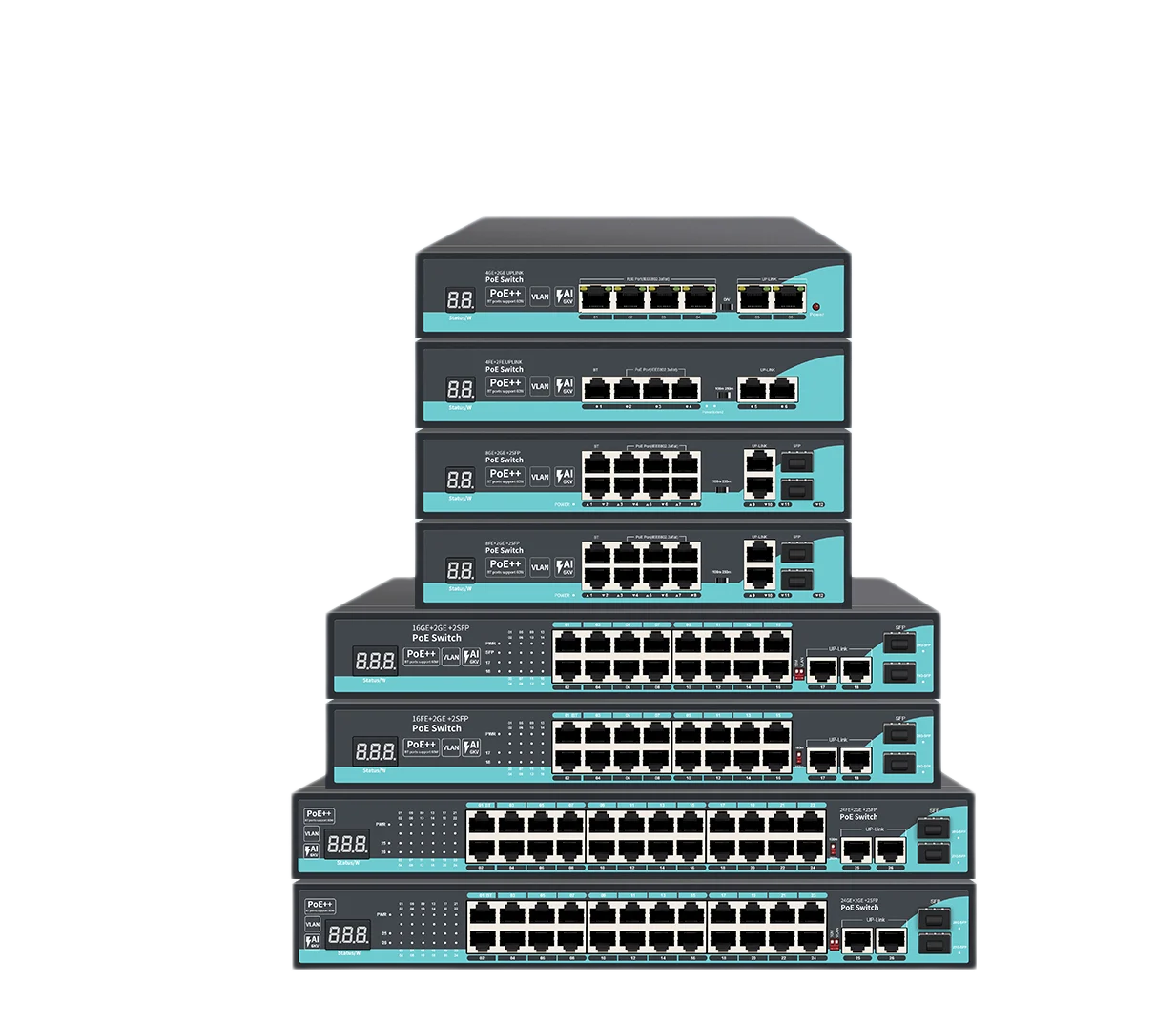
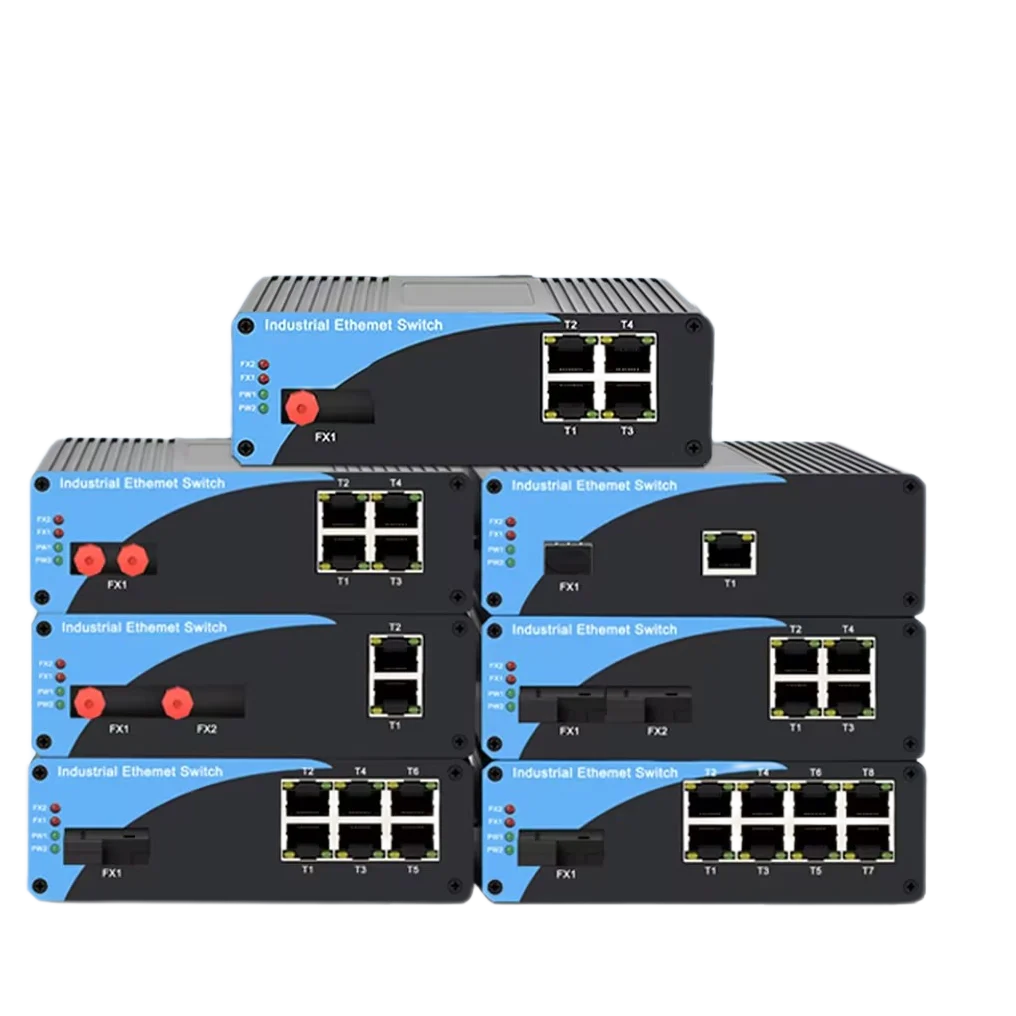




1. What Are We Even Talking About?
Before diving into specifications, let’s pin down the real-world definitions of these four PoE switch categories. The industry often piles up marketing jargon, but at Wanglink, our engineers and site teams use these terms daily to get links up and running.
Standard PoE Switch
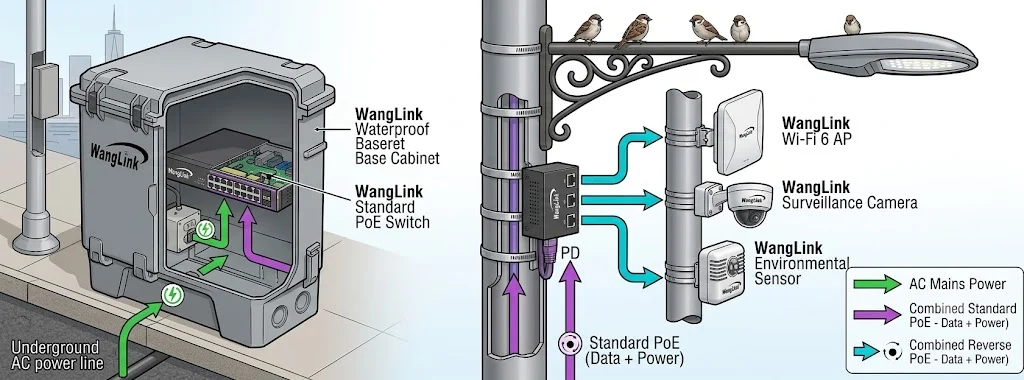
This is the box most integrators picture. It follows IEEE 802.3af (PoE), IEEE 802.3at (PoE+), or IEEE 802.3bt (PoE++). A standard PoE switch takes AC mains power, converts it internally, and acts as Power Sourcing Equipment (PSE). It negotiates power with the connected gadget—say an IP camera or access point—before sending voltage down the twisted pairs. If no valid PD signature is detected, the port stays dark. That handshake prevents frying non-PoE gear.
Reverse PoE Switch
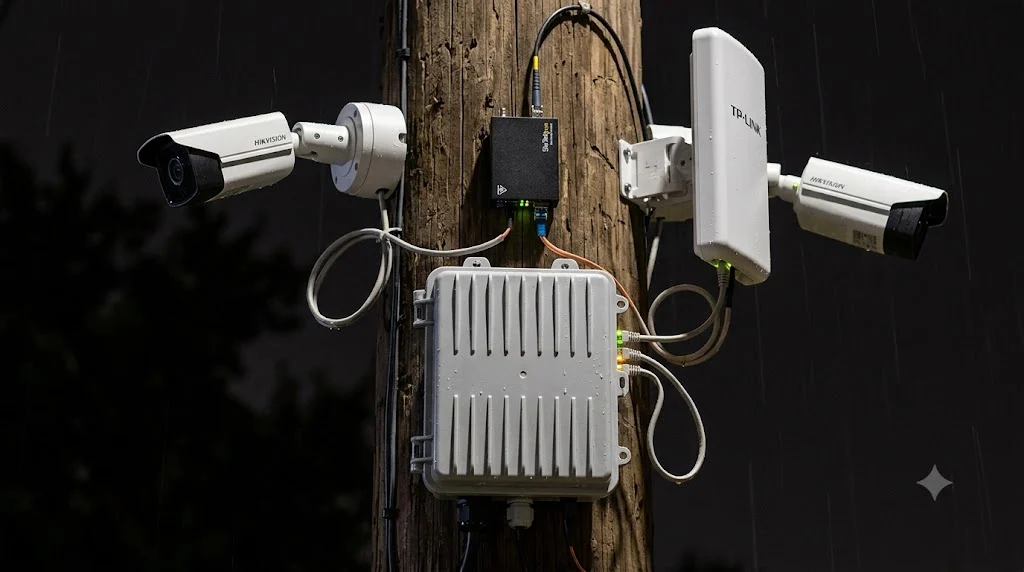
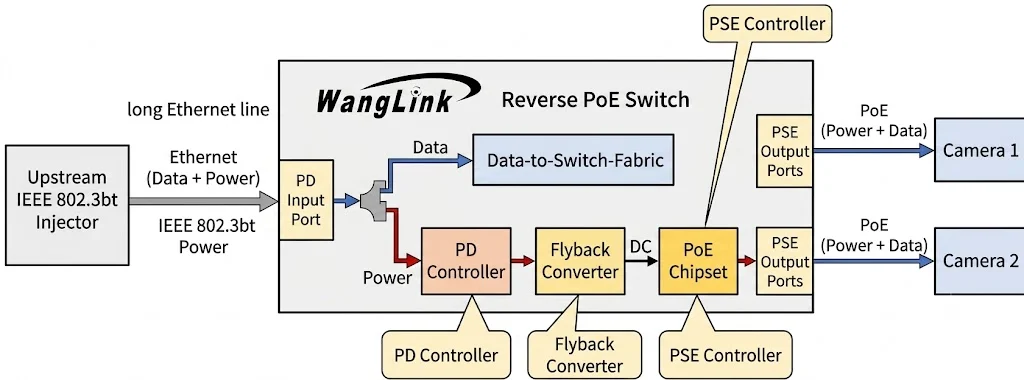
A reverse PoE switch—often called a PoE-powered switch or a Passthrough switch—flips the typical flow. Instead of getting juice from a wall outlet, the switch itself lights up by accepting PoE over its uplink port. It works as a PD (Powered Device) on one interface and simultaneously acts as PSE on its downlink ports, forwarding data and power to end devices. Field crews love this when there’s no AC outlet within 100 meters but a powered Ethernet drop already exists.
Non-Standard Passive PoE Switch
This one throws the IEEE rulebook out the window. A passive PoE switch forces a fixed voltage—commonly 24V or 48V—onto the wire instantly, without any detection or classification. It does not care what’s plugged in. Many Ubiquiti airMAX radios, older MikroTik gear, and low-cost wireless bridges rely on this method. Since the electricity just appears on the pins, plugging a laptop NIC into a passive port usually lets out magic smoke. Technicians label these ports with bright tape to avoid accidents.
PoE PD Switch
A PoE PD switch is a subcategory often confused with reverse PoE. In pure terms, it is a switch that boots up solely from an upstream PSE. But unlike a basic reverse PoE unit, a PD switch can then redistribute power to connected devices using its own internal DC-DC converter. The key point: it’s always a leaf node receiving power. If you cut the incoming PoE cable, the whole switch and its clients die. This design appears heavily in daisy-chain IP surveillance and long-reach IoT gateways.
2. How Each Type Actually Works
Understanding the electrical sequence keeps a simple mistake from turning a $500 switch into a paperweight.
The Handshake (Standard PoE)
A standard 802.3af/at switch sends a tiny 2.7V–10.1V sensing pulse on the cable. It checks the PD’s signature resistor (typically 25 kΩ). Once it sees the valid resistance, it classifies the device (class 0–8) and ramps up voltage. If the link breaks, the switch drops power within 300–400 ms. This is why you see IP cameras reboot during a re-cabling; the switch deliberately cuts and then restarts the process.
Reverse Power Flow in the Field
We wired a WISP tower site in 2022 where the top-of-mast switch was 80 meters from the base station radio. Ripping up concrete for a new AC line was cost-prohibitive. The workaround: we fed PoE++ (60W) from the indoor core switch up a pre-existing outdoor-rated Cat6A cable to a reverse PoE switch. That unit consumed 8W for its own silicon and made 52W available to two PtP radios and a camera heater. The design relies on L2 isolation inside the switch; the PD controller on the uplink port negotiates with the PSE source, while an internal flyback converter generates the local rail for PSE chips on copper ports.
Passive Power & The No-Negotiation Trap
With a non-standard passive switch, the PSE leg is literally a wire-bridge from the external DC power brick to the RJ45 magnetics. A 24V passive switch typically pins DC positive on pins 4,5 and DC return on pins 7,8. Because nothing checks for a PD signature, gear receiving power must tolerate that voltage polarity at all times. Shorten an unused passive port with a cheap tester and the switch will not shut down—it just sits there cooking the magnetics until the thermal fuse blows. That is why every installer double-checks pinouts with a multimeter before plugging in a costly radio.
PD Switch Boot Sequence
A PoE PD switch behaves like a two-stage rocket. First stage: the internal PD interface draws Class 3 (13W) or Class 4 (25.5W) from the PSE. Once the management plane boots, a software-controlled power budget allocates leftover watts to downstream ports. For example, a PD switch pulling 25.5W subtracts self-consumption (~5W) and can then run two 802.3af class 2 cameras. This budget logic means the admin must configure port priorities to avoid a downstream PD from causing an overdraw and rebooting the whole switch.
3. Technical Parameters That Actually Matter
Spec sheets often bury practical thresholds. Here is what directly impacts your site survey and bill of materials.
| Parameter | Typical Range | What It Governs | Real-World Impact |
|---|---|---|---|
| PoE Standard | 802.3af / at / bt | Maximum port power and negotiation method | Using an at switch for a PTZ camera that peaks at 30W causes intermittent reboots. bt (60W) gives headroom. |
| Passive Voltage | 24V DC or 48V DC (non-standard) | Compatibility with radios and CPEs | 24V passive kills 802.3af devices designed for 48V. Pinout confusion burns out PoE splitters. |
| Reverse PoE Budget | 15W / 30W / 60W input | Total available to the switch plus its PD loads | If upstream PSE offers only 30W and switch self-consumes 8W, you have 22W for three cameras—too tight for IR floods. |
| Surge Protection | 2kV to 6kV common mode | Survivability near outdoor antennas | Reverse PoE switches on towers without at least 4kV protection become lightning casualties within one monsoon. |
| PD Detection Timeout | Typ. 300-400ms (802.3af) | Camera boot stability after cable pull | Long negotiation delays cause NVRs to flag false “camera offline” events, flooding monitoring dashboards. |
Confusing Similar Parameters
A common mistake is mixing up PSE output power and total switch power budget. A 16-port PoE+ switch advertising 250W might deliver 30W per port up to 8 ports simultaneously, but the internal power supply cannot handle all 16 ports at full load. This affects how you distribute cameras across the switch to avoid a brownout when IR LEDs turn on at dusk.
4. Where They Shine and Where They Stumble
Standard PoE Switch
- Works best: Office LANs, enterprise access points, high-end surveillance with PTZ cameras. Anywhere safety and protocol compliance matter for asset warranty.
- Limits: Needs local AC power. Legacy non-802.3 gear like some precision sensors still needs a handshake bypass adapter.
- Moving forward: The push is now for all-Port bt (90W) to run building management devices—PoE lighting and thin-client monitors.
Reverse PoE Switch
- Works best: Outdoor digital signage poles, remote sheds with no utility power, Wi-Fi bridging nodes on light poles, and IoT sensor clusters where adding an outlet costs more than the hardware.
- Limits: The upstream PSE becomes a single point of failure; the maximum available downstream power drops by the switch’s own heat loss. Cable voltage drop at long distances can further starve the PD switch.
- Current trend: SPoE (Single Pair Power over Ethernet) extension for multi-drop sensors using 10BASE-T1L, but for now, reverse PoE remains the go-to for quick outdoor daisy-chains.
Non-Standard Passive PoE Switch
- Works best: WISP backbone links with fixed-install radios (e.g., airFiber, Mimosa), single-purpose CPE networks where all gear uses the same passive pinout.
- Limits: No device protection. A junior tech plugging in a laptop can take down a link and ruin a port. Negates any smart power monitoring.
- Industry direction: Many manufacturers are slowly migrating 60GHz and 5GHz CPEs to 802.3af/at for manageability, but passive 24V remains firmly entrenched in tower power amplifiers.
PoE PD Switch
- Works best: In-cabinet industrial automation, daisy-chained perimeter cameras, digital signage strips. Any setup where you only want to pull a single cable to a remote split point.
- Limits: Budget arithmetic gets messy under partial load. If you don’t set port priorities, a new device can trigger an over-current lockout, shutting the whole unit until a manual reboot.
- Future view: USB-C PD and PoE convergence may impact this niche, but ruggedized PD switches still win on cable reach and weatherproofing.
5. Side-by-Side Comparison
This table strips away hype and lines up the architectures so you can quickly identify what fits a job ticket.
| Feature | Standard PoE Switch | Reverse PoE Switch | Passive PoE Switch | PoE PD Switch |
|---|---|---|---|---|
| Power Source | AC mains or DC adapter | Upstream PSE via Ethernet | External DC brick (usually) | Upstream PSE via Ethernet |
| Negotiation | IEEE 802.3af/at/bt handshake | PD negotiation on uplink; PSE negotiation on downlinks | None; voltage applied immediately | PD negotiation on uplink; PSE on downlinks |
| Device Protection | Signature detection prevents wrong devices | Yes, using dual-stage detection | Zero; burn risk is high | Yes, but budget overdraw can lock the switch |
| Common Install | Office, warehouse, hospital | Towers, poles, remote enclosures without AC | WISP PtP links, solar sites | Daisy-chain cameras, IoT field gateways |
| Self-Consumption | Fans and chips draw from own PSU | Deducted from incoming PoE budget | Directly from external brick | Deducted from PSE before feeding ports |
6. Real-World Setup Examples
Parking Lot Surveillance Without Trenching
A warehouse needed four 4K cameras covering a remote employee lot, but the nearest building power was 200 meters away. Trenching a new AC line and handling permits was quoted at $6,000. Instead, the team used an existing fiber backbone terminating in a site media converter. A PoE++ injector (90W) was placed indoors and sent power over a new outdoor Cat6A cable to a reverse PoE switch mounted in a NEMA enclosure at the lot’s edge. That switch consumed 10W and had 80W left. It then powered all four cameras and their IR illuminators. Because the reverse switch used standard 802.3at negotiation on its downlinks, the cameras automatically rebooted on a watchdog-triggered port cycle. The entire electrical budget was monitored from the NVR via SNMP.
Tower Top Radio Ring
On a 45-meter tower with three sectors and a relay radio, a bridge-mounted passive PoE switch fed 24V to four airMAX radios. The backhaul dish used its own shielded injector. The choice of passive switch was deliberate: all radios operated on 24V passive with compatible pinouts. A dedicated DC rain-tight power supply at the tower base pushed 48V up a thick copper pair, and a local step-down converter dropped it to 24V for the passive switch. This kept RF noise low and removed active switching components prone to freezing in -30°C winters. But a strict labeling rule was enforced: red tape on every Ethernet cable end signaled “passive 24V only.”
Point-to-Multipoint Campus Pd Switch
A campus installed a ring of nine IP speakers and small announcement displays. To avoid a spiderweb of power strips, they used a master 802.3bt switch delivering 75W to a PoE PD switch in a shed. The PD switch booted on that 75W, kept 12W for its own processor, and then carefully allocated 15W to three field speakers and two 7W wayfinding displays. The IT team set port priority so that if the total draw crept up, a display port was turned off before the speakers lost emergency paging capability.
7. Common Misconceptions
“Reverse PoE and PoE PD switches are the same thing.”Not exactly. All reverse PoE switches are PDs on the uplink, but a dedicated PoE PD switch usually implies a specific power budgeting chipset and software that manage downstream PSE more granurally. In contrast, some simple reverse switches just bridge power passively to the copper ports without per-port PD detection.
“If a passive PoE switch says 48V, it will work with any 48V PoE device.”This is a dangerous assumption. Passive 48V means the voltage is present end-to-end constantly, without checking the signature resistance. An 802.3af device expects a negotiation phase before voltage arrives. Plugging it into a passive 48V port can destroy the device’s Ethernet magnetics and PoE controller IC. Only use passive sources with gear explicitly documented as supporting passive power.
“A reverse PoE switch can deliver the same power to all ports as a standard switch.”No, because the reverse switch’s total budget is capped by what the upstream PSE delivers. A 90W injector feeding a reverse switch still leaves around 75–80W usable after line loss and self-heat, while a standard 8-port PoE+ switch with a built-in 150W PSU can easily drive four 30W loads simultaneously. Budget planning must happen from the PSE outward, not at the downstream port level.