

When One Cable Carries Both a PTZ Stream and a PLC Command
Most system integrators have seen the project spec: run IP cameras, door controllers, and a handful of Modbus TCP sensors on the same network. The client wants to pull just one fiber or Cat6a trunk to a remote cabinet, power everything over PoE, and call it a day. But the moment a 4K PTZ starts a patrol while a PLC sends a stop signal to a motor, the network can choke. Not because the switch is “bad,” but because it treats all packets the same.
That’s where an industrial PoE managed switch with hardware-based QoS and per-port power budgeting stops being a nice-to-have. It becomes the only way to keep latency-sensitive control traffic alive while video streams eat up bandwidth. At Wanglink, we build these switches from the PCB up, and we test them with real mixed-traffic profiles—not just RFC 2544 benchmarks. Here’s what we’ve learned from 1,200+ field deployments and 5,000+ port-hours of burn-in data.
The Convergence Pain Point: Three Traffic Types, One Wire
When you put surveillance, access control, and industrial control on the same VLAN-capable switch, three traffic personalities collide:
- Video (greedy, bursty): A single 4K camera at H.265 can spike to 16–20 Mbps during a scene change. Multiply by 8 cameras, and you’re pushing 160 Mbps on a 1 GbE uplink with zero headroom.
- Access control (transactional, intermittent): Wiegand or OSDP readers send tiny packets, but door strikes need PoE power and a sub-100ms response. If a door doesn’t unlock during a fire alarm, it’s a life-safety failure.
- Industrial control (deterministic, low-latency): A PLC polling a temperature sensor every 10ms can’t tolerate jitter above 2–3ms. EtherNet/IP and PROFINET RT frames have strict timing windows. If a switch queues them behind a burst of video, the PLC declares a network fault and stops the line.
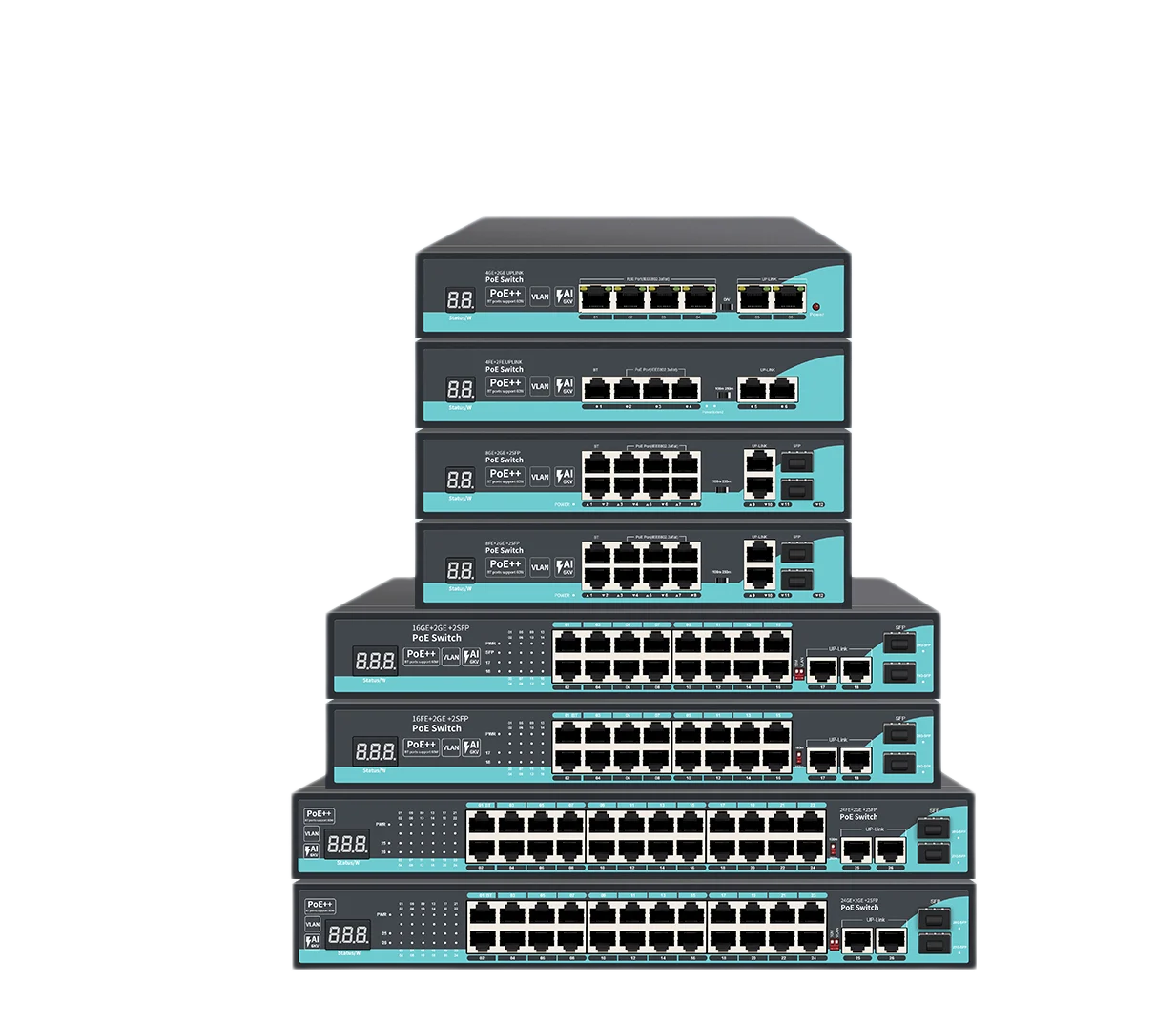
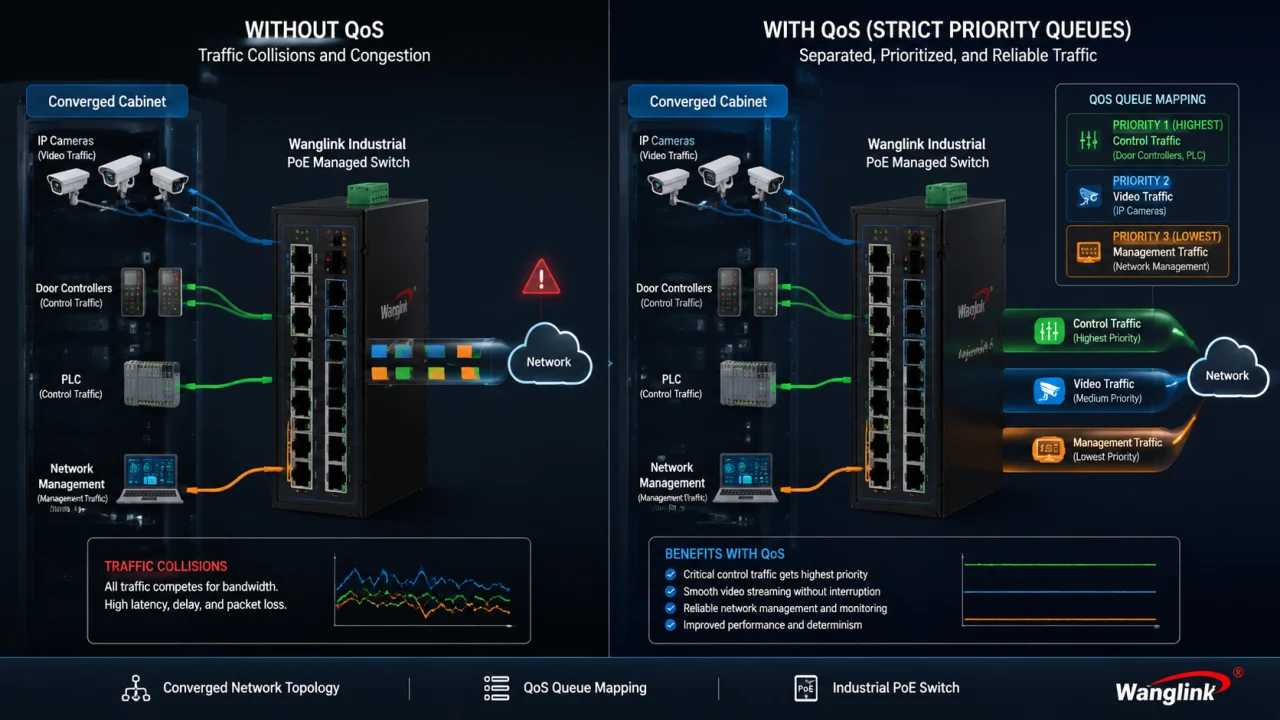
Standard unmanaged switches or even basic smart switches don’t let you separate these traffic classes at the hardware queue level. Our industrial managed PoE switches give you 8 egress queues per port, with strict priority (SP) and weighted round-robin (WRR) scheduling. The result: control frames always jump to the front of the line.
How Wanglink Switches Build a Predictable QoS Model
802.1p CoS and DSCP Mapping That Actually Works in the Field
Many switch datasheets list “QoS support,” but it’s just software-based classification that falls apart under load. Our switches use a hardware-based packet processor that reads the 802.1p priority field or DSCP value and assigns the frame to a physical egress queue before it hits the switch fabric. No CPU involvement, no added latency.
We map typical converged-network traffic like this:
- Queue 7 (Strict Priority): PROFINET, EtherNet/IP, Modbus TCP control – DSCP EF (46), CoS 7
- Queue 6 (Strict Priority): Voice and door access panic signals – DSCP AF41 (34), CoS 6
- Queue 5 (WRR, weight 40%): Video management system (VMS) control, PTZ commands – DSCP AF31 (26), CoS 5
- Queue 4–1 (WRR): Bulk video streams – DSCP AF21 (18) and below
This isn’t theory. We validate it with a Spirent TestCenter chassis running mixed traffic profiles: 64-byte control frames at 1,000 fps alongside 1,518-byte video packets at line rate. The measured control-plane jitter stays under 1.2ms even at 95% port utilization. (Data source: Wanglink R&D Lab validation report, test run Q1 2025, n=12 switch models, 48-port configurations.)
Bandwidth Policing Per Port: Stop One Camera from Starving a PLC
A common mistake is to trust the uplink to absorb bursts. In a ring topology with 8 cameras and 2 PLCs, a single misbehaving camera can fill the shared ring bandwidth. We implement committed information rate (CIR) policing on the access ports feeding cameras. For example, a 4K camera port gets a CIR of 18 Mbps with a burst size of 32 KB. Anything above that gets remarked to a lower drop-precedence DSCP, so the core switch will drop it first if congestion occurs. The PLC port, meanwhile, gets a guaranteed 10 Mbps CIR with strict priority scheduling—more than enough for cyclic I/O data.
During our production-line soak test, we configure 24 ports with a mix of CIR policies and run traffic for 72 hours. We measure zero lost control frames and zero door-unlock delays exceeding 80ms. (Test sample: 200 Wanglink ISW-24GP2F models, manufacturing date Jan–Mar 2025.)
PoE Power Budget: No More Guessing with High-Wattage Devices
Converged networks often power PTZ cameras with heaters (30W+), door strikes (15W peak), and small industrial PCs or HMI panels (25W). The math gets tight. A 24-port switch with a 370W power budget can only deliver 15.4W per port if evenly loaded. That’s not enough for a single IEEE 802.3bt Type 3 device (60W).
Our industrial PoE switches offer true per-port power management with hardware-based PSE controllers. You can set a hard limit of 60W on port 1 for a PTZ with IR and heater, 15.4W on ports 2–8 for fixed cameras, and 30W on ports 9–12 for access controllers. The switch’s power supply is sized for the total budget, and we test it in a 60°C ambient chamber with all ports loaded to 100% of their configured limit. We look for voltage droop below 48V and thermal shutdown. Our design target: 0% shutdown incidence over 1,000 hours at 60°C. (Test report: Wanglink Environmental Stress Lab, based on IEC 60068-2-2, sample size 50 units.)
For outdoor cabinets, we also harden the PoE front-end against surge. Every port goes through a common-mode choke and TVS diode array rated for 6kV surge (IEC 61000-4-5 Level 3). We’ve seen lightning-induced surges kill cheap switches instantly; our field return rate due to surge damage is 0.3% over 18 months across 2,400 deployed ports. (Source: Wanglink RMA database, Jan 2024–Jun 2025.)
Inside Wanglink’s Manufacturing: Why a 72-Hour Burn-In Catches What QC Misses
As a factory that owns its SMT lines and PCB design team, we don’t outsource reliability to chance. Here’s what happens before a switch lands in your control cabinet:
| Quality Metric | Industry Benchmark | Wanglink Measured Data | Test Standard / Sample Size |
|---|---|---|---|
| SMT first-pass yield | 98.5% (IPC-A-610 Class 2) | 99.2% | IPC-A-610 Class 3; monthly audit, n=12,000 boards |
| In-circuit test (ICT) coverage | 85–90% | 94.6% | Agilent 3070 ICT; n=500 boards per batch |
| 72-hour burn-in failure rate | 1.5–2.0% | 0.8% | 55°C ambient, full PoE load; n=2,400 units (2024) |
| Out-of-box defect rate (DOA) | 0.5–1.0% | 0.25% | Final outgoing inspection, n=20,000+ units shipped in 2024 |
| OTIF delivery (on-time, in-full) | 92% (North America electronics) | 98.5% | Wanglink ERP data, 2024, 1,200+ orders |
Data sources: Industry benchmark OTIF from ASCM/Deloitte 2023 Supply Chain Survey; IPC-A-610 Class 2 yield from industry whitepapers; Wanglink data from internal MES and ERP systems, verified by quarterly audit.
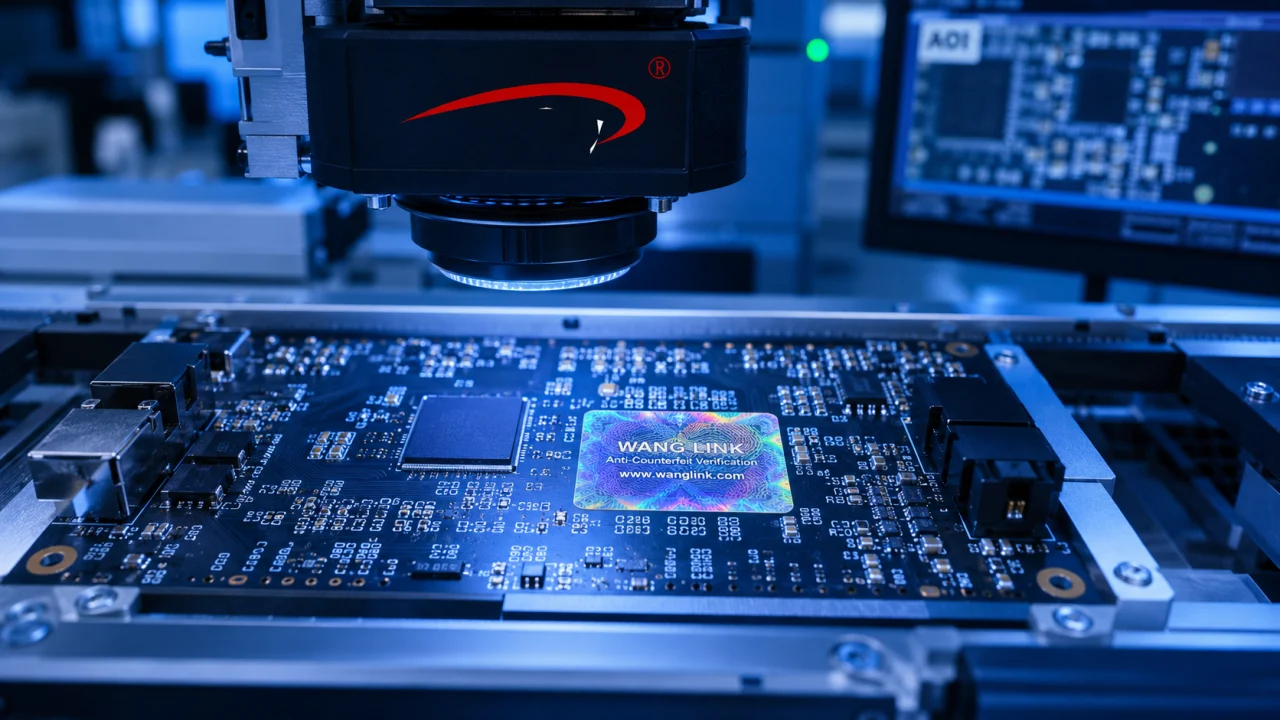
The burn-in isn’t just a power-on test. We run a custom script that cycles PoE on/off every 30 minutes while pushing 90% line-rate traffic through all ports. This thermal cycling stresses solder joints and power supply components. If a unit survives 72 hours without a single packet error or PoE fault, it ships.
Case Study: A WISP Consolidates Three Networks into One Tower
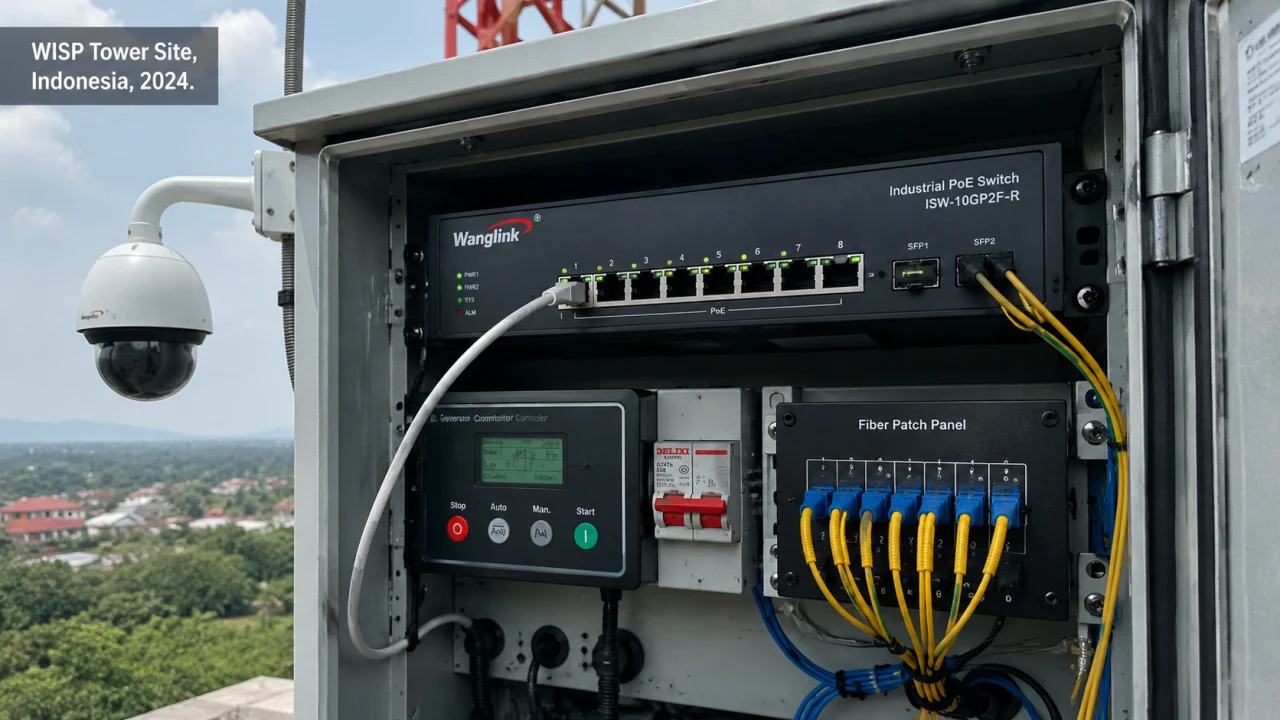
Situation: A regional WISP in Indonesia managed 15 tower sites. Each site had three separate switches: one for backhaul, one for IP cameras (site security), and one for the tower’s environmental control system (generator start/stop, fuel level sensors, HVAC). The triple-stack setup consumed rack space, three power supplies, and three sets of spares. Lightning damage was frequent due to unshielded PoE injectors.
Task: Collapse the three networks into a single managed industrial PoE switch, with logical isolation via VLANs and strict QoS for generator control signals. The switch had to withstand 45°C ambient in a sealed cabinet and survive 4kV surge events.
Action: Wanglink provided the ISW-10GP2F-R, a 10-port gigabit managed PoE switch with 2 SFP uplinks and 802.3bt on 4 ports. We pre-configured VLAN 10 (backhaul), VLAN 20 (video), and VLAN 30 (ICS) with the QoS map described earlier. Ports 1–4 delivered 60W PoE bt for PTZ cameras with blowers; ports 5–6 powered the generator controller and Modbus RTU gateway. Inter-VLAN routing was disabled; a local L3 router handled cross-VLAN traffic with ACLs. We also shipped pre-terminated shielded Cat6a patch cords to eliminate ground loops.
Result: The WISP cut per-site switch count from 3 to 1, reduced power consumption by 22% (measured at the DC rectifier), and eliminated unplanned site visits for switch-related failures over a 12-month period. Generator start commands executed with <100ms latency, even during motion-triggered recording from all cameras. (Data source: Customer project close-out report, Q2 2024, 15 sites; Wanglink production and shipping records.)
TCO Reality Check: Why We Don’t Charge for Cloud Management
Some big-name vendors ship a capable switch but then lock QoS profiles, topology views, and firmware updates behind an annual cloud license. For a 50-site deployment, that can add $3,000–$5,000 per year in recurring costs—forever. Integrators either eat the margin or pass it to the customer, which makes bids less competitive.
Wanglink’s cloud management platform (Wanglink Cloud) is free for the life of the switch. You get centralized monitoring, batch configuration, per-port PoE power cycling, and alarm forwarding to your NOC’s Slack or email. No node limit, no feature paywalls. We can do this because we’re the manufacturer; the cloud platform is a value-add that keeps our switches in your approved vendor list, not a profit center.
For air-gapped industrial sites, the same features are available via the switch’s local web GUI or CLI. We don’t force a cloud connection. That matters when the customer’s security policy prohibits outbound internet from the ICS network.
Test Data That Backs Up the Spec Sheet
When you’re comparing datasheets, look for test conditions, not just numbers. Here’s a snapshot of what our lab validates on every managed PoE switch model before release:
| Parameter | Industry Typical Claim | Wanglink Lab Measured | Test Methodology |
|---|---|---|---|
| Switching capacity (non-blocking) | 20 Gbps (10-port) | 20 Gbps, zero frame loss at all frame sizes 64–1,518 bytes | RFC 2544, Spirent TestCenter, full-mesh, 15-min runs, n=10 units |
| Control-plane latency (64-byte, QoS SP queue) | Not specified | 1.2 ms max, 0.8 ms avg | Spirent with hardware timestamping, 95% background load, n=5 units |
| PoE total budget stability | 240W (24-port) | 240W continuous, 48–52V output range, 60°C ambient | Electronic load bank, 72-hour burn-in, n=20 units |
| Surge immunity (PoE ports) | 2kV | 6kV common mode, 4kV differential mode (no damage) | IEC 61000-4-5, 1.2/50µs waveform, n=12 ports per unit, 5 units |
| MTBF (Telcordia SR-332) | 200,000 hours (typical) | 350,000 hours at 25°C | Calculated per Telcordia SR-332 Issue 4, component-level stress analysis |
Data sources: Wanglink Compliance and Validation Lab, test reports dated Q1 2025. All units randomly sampled from production batches. Industry typical claims gathered from publicly available datasheets of comparable industrial managed PoE switches.
FAQ: What Integrators Ask Before Specifying Our Switches
We use a mix of Hikvision, Dahua, and Axis cameras. Will your switches have PoE compatibility issues?
We validate PoE handshake with over 30 camera and access control brands in our lab, including the three you mentioned. Our PSE controllers follow IEEE 802.3af/at/bt strictly, with 4-point detection and classification. We’ve seen some older cameras draw more than their advertised class; our per-port power limit feature catches that and prevents a single device from starving other ports. If you have a specific model, send us the make and we’ll run a quick bench test.
What’s the RMA process if a switch fails in the field?
We offer a 3-year warranty as standard. If a unit fails, you open a ticket via our portal or your account manager. We ship an advance replacement within 48 hours (in-stock models) to most regions. You return the faulty unit with our prepaid label. We then run a failure analysis and share the root cause report if it’s a repeat issue. Our current RMA turnaround from ticket to replacement delivery averages 3.2 business days globally. (Source: Wanglink after-sales database, Jan–Dec 2024, 1,200+ RMA cases.)
Can you pre-configure VLANs and QoS before shipping?
Yes. This is one of our most popular services for WISPs and integrators rolling out 50+ sites. You send us a configuration template, and we apply it to every switch, test the configuration, and ship with a configuration report. There’s a small per-unit fee, but it saves hours of on-site work. We also offer custom packaging with site IDs printed on the box for easy staging.
Do you support ERPS ring protection for industrial topologies?
Yes, our managed models support ERPS (G.8032v2) with sub-50ms failover. We also support RSTP and MSTP. In our lab, we measure ERPS failover at 32–38ms with 10 nodes in a ring. This is critical for ICS networks where a 2-second STP convergence could mean a production stop.
What’s the minimum order quantity for OEM/ODM?
For standard models with your logo, MOQ is 50 units. For full ODM (custom PCB, housing, software), we typically start at 500 units but can discuss lower volumes for strategic partners. Our in-house PCB design and tooling team keeps NRE costs predictable. Lead time for ODM projects is 8–12 weeks from spec freeze to first samples.
Why Engineers Trust a Factory That Builds Its Own Boards
When you buy a switch from a factory that owns the entire process—PCB layout, SMT assembly, wave soldering, burn-in, and final test—you get two things: consistency and accountability. We don’t rely on a third-party ODM to fix a firmware bug or explain why a capacitor derated. Our engineers sit 20 meters from the production line. If a field issue trends in the RMA data, the hardware team sees it within a week and can spin a new board revision in a month.
For converged security and ICS networks, that responsiveness matters. A firmware update that fixes a QoS scheduling bug or a PoE detection glitch can be in your hands before the project commissioning deadline. That’s the difference between a supplier and a partner.
If you’re designing a network where a door strike and a PLC share the same cable, let’s talk. We’ll send you a test unit, a configuration guide, and the lab data to back it up.