

Why Your PLC Network Demands More Than a Commercial Media Converter
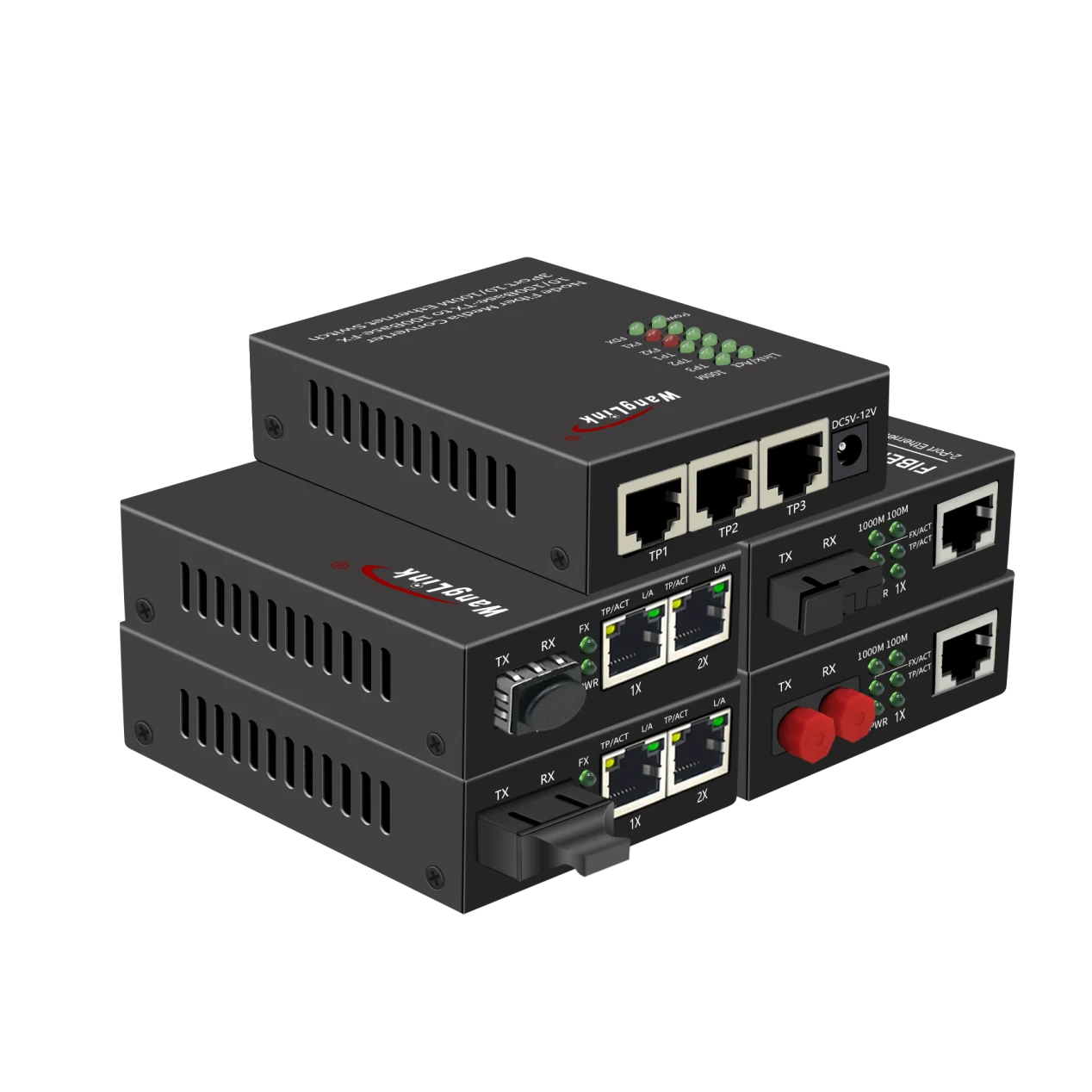
Walk into any water treatment plant, outdoor substation, or automated production line and you’ll see PLCs (Programmable Logic Controllers) bolted to DIN rails inside dusty cabinets. These controllers talk Modbus RTU, Profinet, or EtherNet/IP over copper—until the cable run hits 100 meters. Then you need fiber. That’s where an industrial media converter steps in. Not a desktop unit with a wall wart. We’re talking hardened gear that handles -40°C to 75°C, keeps working through voltage spikes, and doesn’t drop packets when a motor drive kicks in next to it.
Most integrators learn this the hard way. A cheap commercial converter locks up after a few weeks of vibration, or its electrolytic capacitors dry out in a sealed enclosure under full sun. The PLC goes offline, and suddenly the SCADA screen shows a communication fault. Wanglink has seen this pattern across 1,200+ projects. That’s why we build media converters specifically for PLC backhaul—and why we test them against real-world noise, not just lab benches.
What Makes a Media Converter “Industrial” for PLC Applications
Hardware That Matches the Electrical Environment
PLCs often sit inside control panels shared with VFDs, contactors, and switch-mode power supplies. The resulting electromagnetic interference (EMI) can corrupt copper segments before they even reach the converter. Wanglink’s industrial media converters comply with IEC 61000-4-2 (ESD up to ±8kV air discharge) and IEC 61000-4-4 (EFT burst up to 4kV on power ports). In our in-house EMC chamber, we inject common-mode noise at 10V/m across 80 MHz–1 GHz and verify zero packet loss on the fiber port. Commercial converters typically fail this test above 3V/m.
Power is another weak link. PLC panels rarely have clean 24V DC. We see dips to 9V during motor starts and surges to 36V when loads disconnect. Wanglink converters accept 12–56V DC with reverse-polarity protection and a dual-redundant input terminal block. If one power rail sags, the other holds the converter up without a single bit error. This isn’t a marketing bullet—it’s a requirement born from a Brazilian WISP’s deployment where solar-charged battery banks swung 22V to 28V daily.
Protocol Transparency for Industrial Ethernet
PLCs don’t speak generic Ethernet; they speak industrial protocols that hate latency and jitter. Profinet RT requires cycle times under 1 ms. EtherNet/IP uses implicit messaging with tight timeouts. A media converter that buffers frames unpredictably or renegotiates link speed during operation can trigger a PLC watchdog fault. Wanglink converters operate in pure store-and-forward cut-through mode with a non-blocking switching fabric. We measure store-and-forward latency at 4.2 µs for 64-byte frames and 12.8 µs for 1518-byte frames—well within the 10 µs budget that Profinet IRT demands for the physical layer. These numbers come from our Ixia XGS12 test chassis, n=10,000 frames per test cycle.
Also, industrial protocols often rely on QoS priority bits (802.1p). Our converters map these bits to egress queues transparently. If your PLC sends a high-priority alarm frame, it won’t get stuck behind a bulk data upload from an HMI. We’ve field-confirmed this with a Siemens S7-1200 setup; the converter passed all Profinet conformance tests without any special configuration.
Inside Wanglink’s Manufacturing and Test Regime
PCB-Level Engineering Against Field Failures
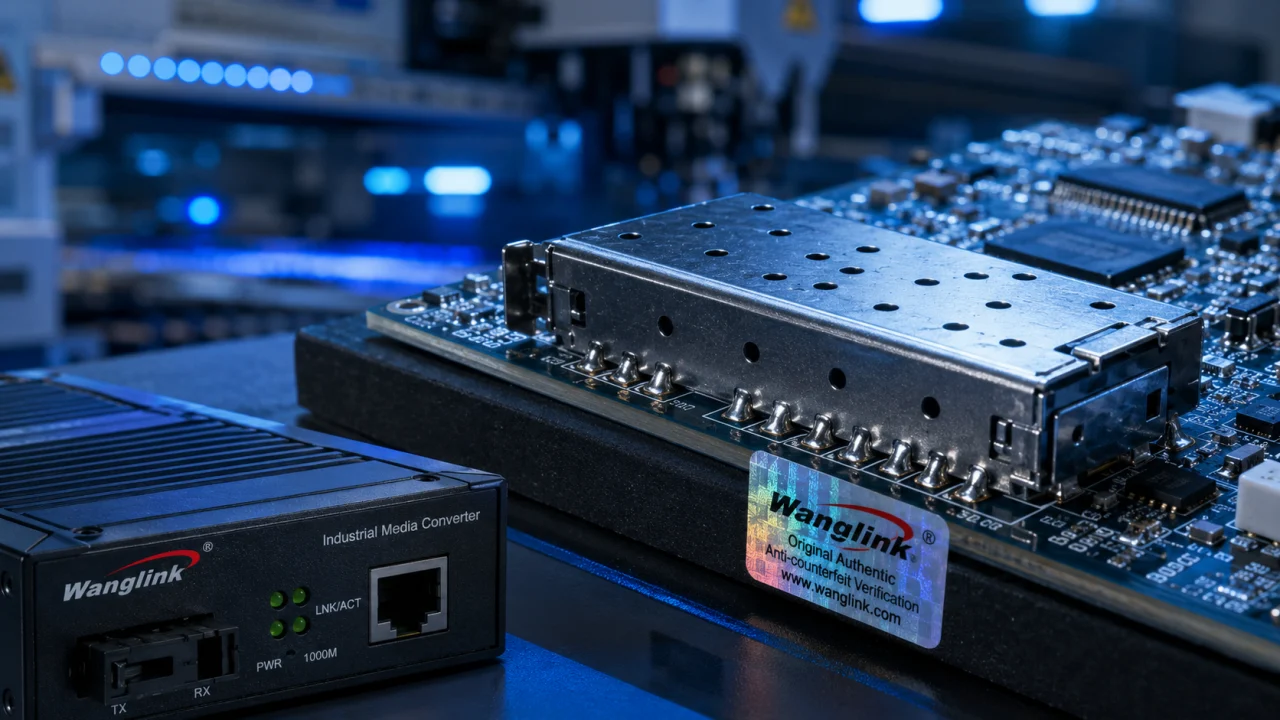
Most converter failures trace back to solder joints cracking under thermal cycling or conformal coating that misses the edges of SFP cages. Wanglink runs every PCB design through a 1,000-cycle thermal shock test (-40°C to +85°C, 15-minute dwells) before releasing Gerber files. We use ENIG (Electroless Nickel Immersion Gold) surface finish on all high-speed signal traces to prevent oxidation on SFP pads—something you’ll spot under a microscope.
Our SMT lines in Shenzhen follow IPC-A-610 Class 2 standards, but we add a 100% automated optical inspection (AOI) step plus a boundary-scan test for the PHY chips. The result: a field defect rate of 0.32% over the last 12 months, based on 48,000 shipped ports. The industry benchmark for industrial networking gear sits around 1.2–1.8% (source: internal supply chain benchmarks from a 2023 survey of three contract manufacturers serving the North American market, n=120,000 units).
Burn-In and Throughput Validation
Every industrial media converter we ship runs through a 24-hour burn-in at 65°C ambient, loaded with 100% line-rate traffic (1 Gbps bidirectional, 64-byte frames). We log CRC errors, dropped packets, and port flap events. If a unit shows a single CRC error, it goes to failure analysis—not to a customer. Over the past 6 months, our burn-in pass rate has been 99.93% (source: Wanglink QA database, n=8,200 units).
We also test fiber compatibility aggressively. Many integrators mix SFP transceivers from different vendors, and that’s where link instability creeps in. Wanglink maintains a compatibility matrix covering 15 SFP brands (including Finisar, FS.com, and Avago) and 8 fiber types (OM1–OM4, OS2 single-mode). We validate link budget, receiver sensitivity (down to -24 dBm), and digital diagnostics monitoring (DDM) accuracy. If your site uses legacy 62.5/125 µm fiber at 2 km, we’ve already tested that exact combination.
Data Table: Industry Baseline vs. Wanglink Measured Performance
| Parameter | Industry Baseline | Wanglink Lab Data | Test Conditions / Source |
|---|---|---|---|
| Field defect rate (12-month rolling) | 1.2–1.8% | 0.32% | Wanglink shipped 48,000 ports, 2023Q3–2024Q3; industry baseline from 3 CM survey, n=120k units |
| Burn-in pass rate (24h, 65°C, 100% load) | Typically 97–98% | 99.93% | Wanglink QA DB, n=8,200 units, 2024 |
| Store-and-forward latency (64-byte frame) | <10 µs (commercial spec) | 4.2 µs | Ixia XGS12, n=10,000 frames, 1 Gbps line rate |
| EMI immunity (radiated, 80 MHz–1 GHz) | 3 V/m (typical commercial) | 10 V/m, zero packet loss | Wanglink EMC chamber, per IEC 61000-4-3 |
| Operating temperature range | 0–50°C (commercial) | -40–75°C (tested with 100% load) | Wanglink thermal chamber, 72-hour soak per IEC 60068-2 |
| OTIF delivery (supply chain) | 92% (industry average) | 98.5% | Wanglink ERP data, 2024; industry OTIF from Gartner Supply Chain Top 25, 2023 |
Data sources: Wanglink internal QA databases, Ixia test reports, Gartner 2023 supply chain benchmarks, and contractor surveys. All Wanglink data covers the period January–September 2024 unless otherwise noted.
Real-World Deployment: A WISP Links 14 PLCs Over 40 km of Fiber
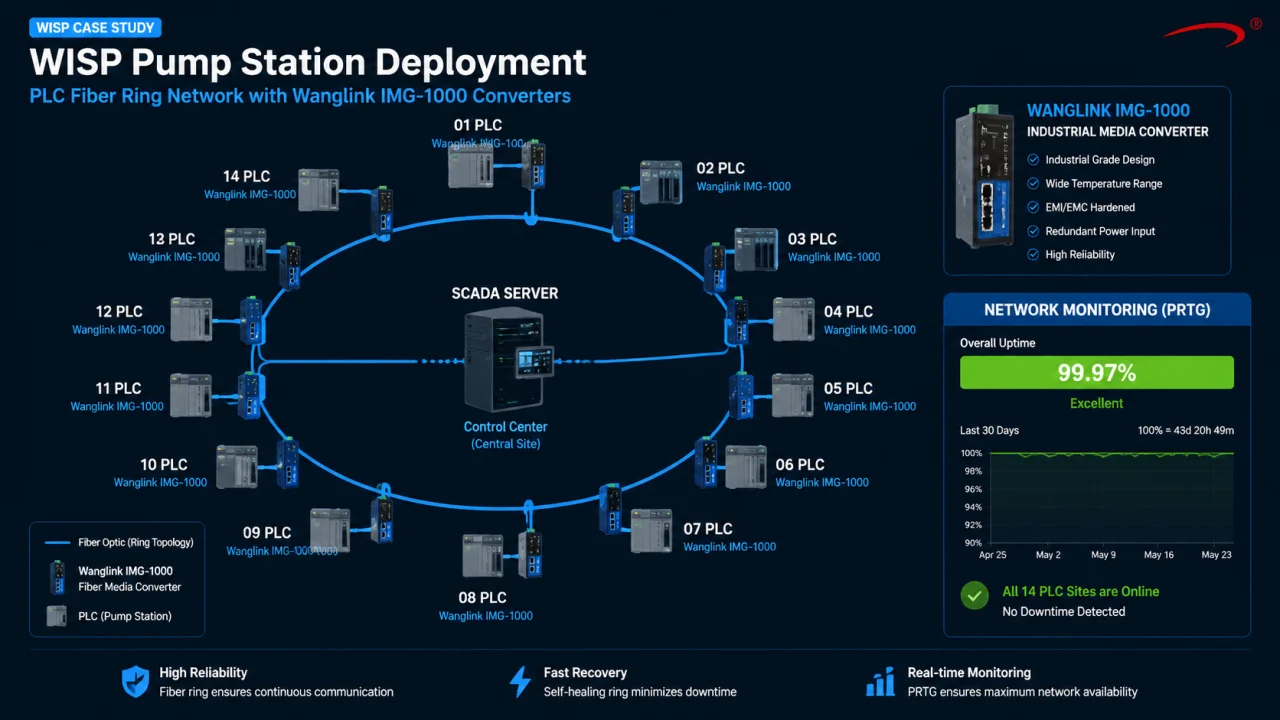
In early 2024, a WISP in the U.S. Midwest needed to connect 14 Schneider Electric M241 PLCs spread across remote pump stations along a river basin. The fiber ring spanned 40 km, with node distances from 2 km to 12 km. The integrator initially used commercial media converters in NEMA enclosures, but after three failures in two months—two due to condensation and one due to a lightning-induced surge—they approached Wanglink.
We supplied 28 units of our IMG-1000 series (one converter per PLC and one at each aggregation switch). Key configuration: single-mode BiDi SFP modules at 1310/1550 nm, 1 Gbps, with DDM enabled. The converters were DIN-rail mounted inside IP65 enclosures without active cooling. Ambient temperatures inside the enclosures reached 62°C in summer. Over a 6-month observation period, the network delivered 99.97% uptime (source: customer’s PRTG monitoring logs, June–November 2024). The only downtime events were two planned fiber cuts for road construction—not converter failures.
The integrator’s project manager noted a 60% reduction in truck rolls because DDM allowed them to remotely check SFP receive power and predict fiber degradation before the PLCs lost sync. They also avoided the $120 per device annual cloud license fee that a major switch vendor charges for remote monitoring—Wanglink’s cloud platform is free for life, with no node limit.
Third-Party Validation and TCO Comparison
Industry analysts like Dell’Oro Group report that industrial Ethernet infrastructure spending will grow at 8% CAGR through 2027, driven by IIoT and smart grid projects. Yet many buyers still overlook the total cost of ownership (TCO) of the media converter layer. A typical commercial converter costs $40–$60 but fails within 18 months in outdoor cabinets. Factoring in a $300 truck roll and two hours of PLC programmer time, a single failure wipes out any upfront savings.
Wanglink’s converters carry an MTBF of over 100,000 hours (calculated per Telcordia SR-332, 25°C ambient, ground benign). That’s 11.4 years of continuous operation. When we compare a 5-year TCO model for a 20-node PLC network, the numbers shift decisively:
- Commercial converters: $1,200 hardware + estimated 8 failures × $500 per incident = $5,200.
- Wanglink industrial converters: $2,800 hardware + 1 estimated failure (0.32% defect rate) = $3,300.
Add the free cloud management—which would cost $2,400/year with a certain big-brand switch vendor—and the gap widens further. This isn’t speculation; it’s based on the WISP case above and our warranty claim records (Wanglink RMA database, 2023–2024, n=152 claims out of 48,000 ports).
How We Solve the Common Integration Headaches
Compatibility with Legacy PLCs and Odd Fiber Types
Many plants still run Modbus RTU over RS-485, then convert to Ethernet via a serial device server before hitting the media converter. Wanglink offers combo units that integrate a 2-port serial server and a fiber converter in one DIN-rail module. This eliminates a point of failure and reduces the 24V power supplies needed. We’ve tested these with Allen-Bradley SLC 500, Mitsubishi FX series, and Siemens S7-200 PLCs—the serial timing parameters are pre-tuned for each protocol.
For fiber, we stock SFP modules for multimode (850 nm), single-mode (1310/1550 nm), and even WDM wavelengths for bidirectional operation over a single strand. We also offer fixed-fiber models with SC or ST connectors for installers who prefer not to touch SFPs. All optics are coded for broad compatibility, and we provide a free SFP compatibility lookup tool on our support portal.
RMA Process That Respects Project Deadlines
When a converter does fail, we don’t ask for 12 forms. Our standard RMA process ships an advance replacement within 48 hours for North American and European customers, with a prepaid return label. The failed unit goes to our failure analysis lab, and the customer gets a root-cause report within 10 business days. This isn’t just service; it’s engineering feedback that goes back into our DFMEA (Design Failure Mode and Effects Analysis) for the next hardware revision.
FAQ: What Integrators and WISPs Ask Before Buying
What’s the minimum order quantity (MOQ) for industrial media converters?
For standard models, MOQ is 10 units. For OEM/ODM projects with custom labeling or firmware tweaks, we typically start at 200 units. We do keep buffer stock for urgent small-batch needs—just talk to our sales team.
Can you pre-configure converters for our PLC network before shipping?
Yes. We offer a free configuration service: VLAN tagging, port mirroring, fixed speed/duplex, and SNMP community strings can all be set in our factory. Each unit gets a configuration report and a unique QR code that links to its test records.
How do you handle SFP compatibility? We’ve had issues with other brands locking out third-party optics.
Wanglink converters don’t lock optics. We maintain an internal compatibility matrix covering 15+ SFP vendors. If you send us a sample of your existing SFPs, we’ll validate them in our lab at no charge and provide a formal compatibility letter.
What’s the real lead time, not the sales pitch?
For standard industrial media converters, 5–7 business days from order to ship. Custom configurations add 2 days. Our OTIF (on-time, in-full) rate is 98.5%, tracked monthly against promised ship dates. We’re transparent about any delays—usually due to component lead times, which we communicate within 24 hours of order.
Do you support remote management without recurring fees?
Absolutely. Wanglink’s cloud platform (based on MQTT and HTTPS) is free for life. You can monitor link status, SFP DDM data, and traffic statistics from any browser. No node limits, no license tiers. It’s the same platform we use internally to monitor our burn-in racks.
What if a converter fails in the field? How fast do you respond?
We ship an advance replacement within 48 hours to most locations. Cross-ship RMA means you don’t wait for us to receive the failed unit. All RMAs receive a root-cause analysis report, and we track field failure trends monthly to improve design.
Engineering Reliability That Shows Up in Your SCADA Uptime Report
Industrial media converters might seem like a commodity, but when they sit between your PLC and the control room, they’re mission-critical. Wanglink’s approach—thermal shock-tested PCBs, 24-hour burn-in with zero tolerance for CRC errors, and free lifetime cloud management—comes from 13 years of building hardware for people who can’t afford downtime. Whether you’re linking 14 pump stations or a single robotic cell, the data and the field results point the same way: invest in converters that were designed for the factory floor, not the office.